
Marine litter survey methods in numbers
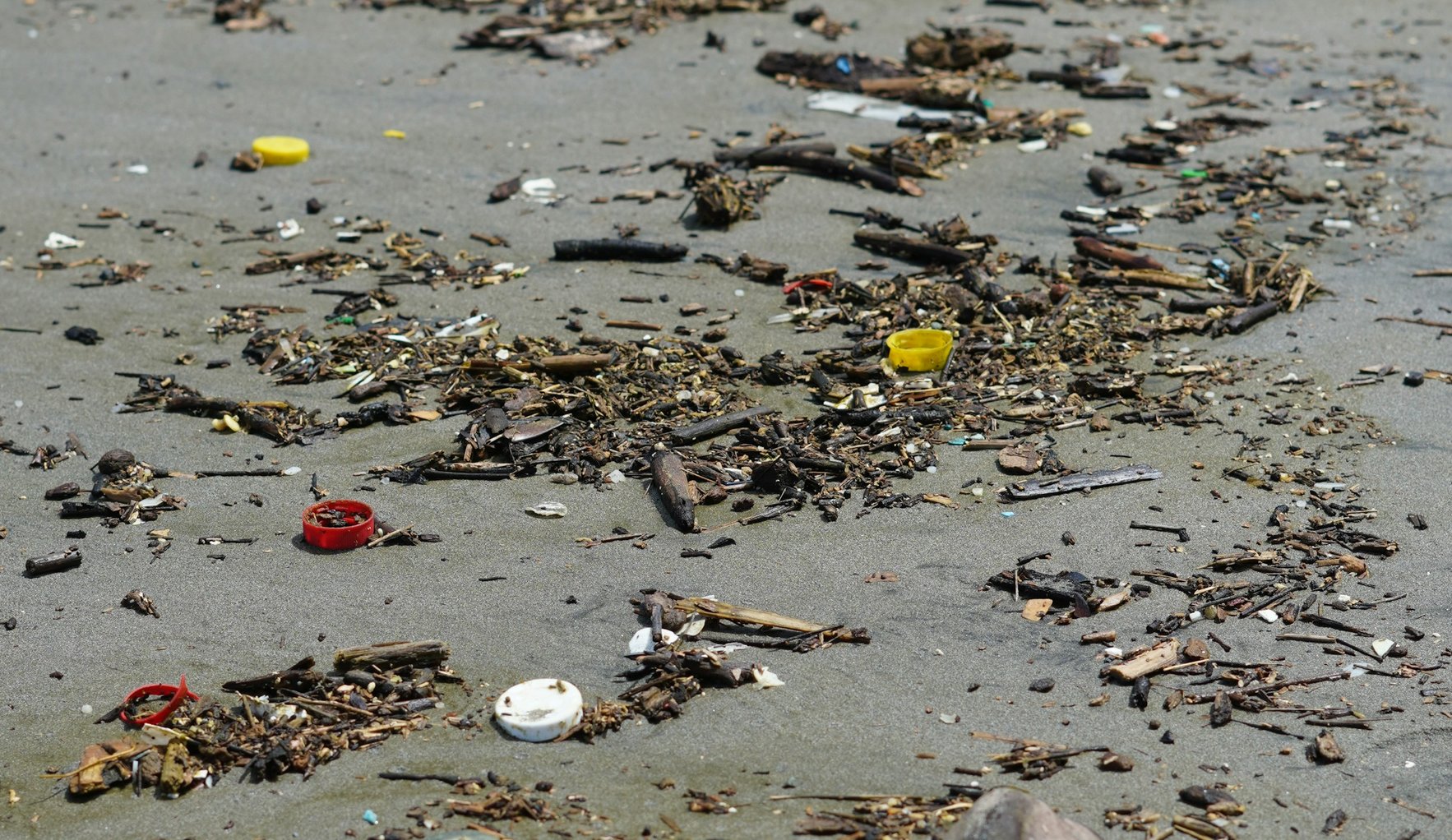
Under the UNEP and IOC guidelines (2009), beach litter is surveyed over a section of at least 100 m, counting items of 2.5 cm or more, at least once a year and ideally every three months (UNEP/IOC guidelines (2009) pp.22, 26, 27). Japan's Ministry of the Environment guideline also covers items of 2.5 cm or more, with once a year as the minimum (Ministry of the Environment, beach litter composition survey guideline, 5th ed. (April 2026, Japanese) pp.1, 5).
This page is part of the Karatsu Data Bank by Karatsu Farm & Food. It sets out the section length, size limits, units and frequency set by international and Japanese guidelines for beach litter, floating litter, seabed litter, microplastics and observation from satellites. We add no conclusions or evaluative words. Page numbers are those printed in the documents. Rankings of litter types are on marine litter types.
| Guideline | Covers | Section or area | Size counted | Unit | Frequency |
|---|---|---|---|---|---|
| UNEP/IOC (2009) | Beach, seabed, sea surface | beach: at least 100 m (sections of 100-1,000 m) | beach: 2.5 cm or more | items per length of beach per period, etc. | at least yearly, ideally every 3 months |
| OSPAR (2010, north-east Atlantic) | Beach | 100 m (also 1 km for items over 50 cm) | pieces under 2.5 cm also recorded | count | 4 times a year |
| NOAA MDMAP (2021, US) | Beach | four 5 m wide transects in a 100 m site | 2.5 cm or more | count | not stated in the 2021 guide |
| Japan, beach litter composition survey (5th ed.) | Beach | 50 m wide along the shore on a beach of 100 m or more | 2.5 cm or more | count plus weight (or volume) | minimum once a year |
| GESAMP (2019) | Beach, surface, water column, seabed, biota | - | set by size class (table below) | count or mass per length, area or volume | - |
| Japan, surface microplastic harmonization guideline (v1.2) | Sea surface microplastics | tow at least 1,000 m² of surface per haul | under 5 mm (mesh about 0.3 mm) | count or weight per m³ or km² | - |
| Japan, offshore survey (FY2025) | Floating litter, surface microplastics, seabed litter | visual, net (about 2 knots for 20 min), bottom trawl | mesh 350 µm | /km², /m³ | every year |
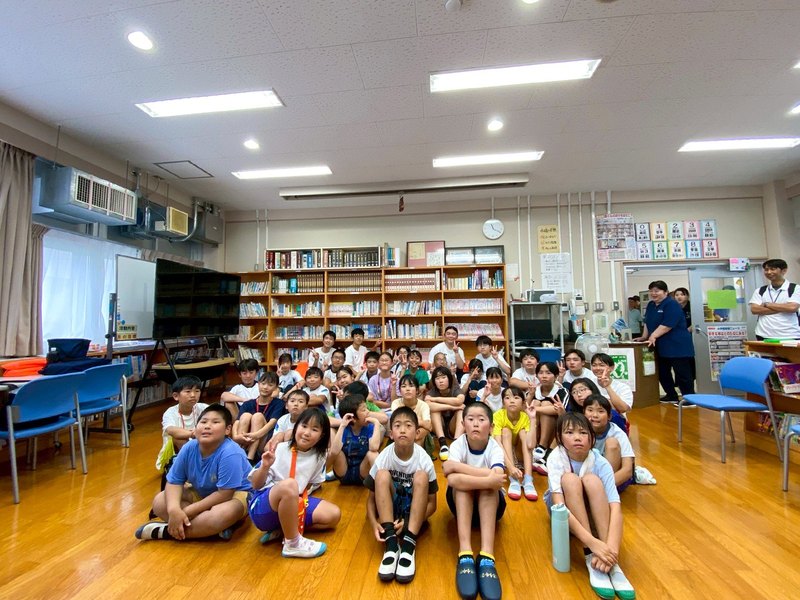
We have run beach clean-ups on Karatsu's shores with schools, companies and local people. Our ongoing learning about the sea and the environment with island schools is described in Island ESD.
See our work
To cite this data or to ask about environmental learning or beach clean-ups on the theme of marine litter surveys for schools and companies.
Contact page
International standardization: guidelines from 2009 to 2019
The UNEP and IOC guidelines (UNEP Regional Seas Reports and Studies No.186) set a beach section of at least 100 m and consider sections of 100 to 1,000 m practical. An annex explains that many surveys count items larger than 2.5 cm × 2.5 cm because this is the minimum disposal size permitted under MARPOL (UNEP/IOC guidelines (2009) pp.22, 25; Annex B p.82). Surveys every three months are also recommended for seabed and floating litter (pp.43, 53).
The GESAMP guidelines (Reports and Studies No.99) cover shorelines, the sea surface and water column, the seabed and biota, and divide litter into five size classes. Units are counts or mass per unit of length, area or volume (GESAMP guidelines (2019) pp.10, 15).
| Class | Size | Note |
|---|---|---|
| Mega | over 1 m | |
| Macro | 25-1,000 mm | |
| Meso | 5-25 mm | |
| Micro | under 5 mm | 330 µm noted as the typical mesh of towed plankton nets |
| Nano | under 1 µm | not considered for monitoring |
An Integrated Marine Debris Observing System (IMDOS), combining remote sensing and in situ observation, was proposed in 2019, with a note that it may become part of the Global Ocean Observing System (GOOS) (Frontiers in Marine Science 6:447). In August 2023 an international workshop in Yokohama agreed a community of practice under GOOS and IMDOS and a roadmap for data integration, according to Japan's Ministry of the Environment (press release, 8 September 2023 (Japanese)).
Japan: how the Ministry of the Environment surveys beach, floating and seabed litter
The ministry's beach litter composition guideline (5th ed.) selects at least one site per prefecture on a beach at least 100 m long, and collects items of 2.5 cm or more within a 50 m wide section from the waterline to the vegetation, recording count and weight (or volume). The category list has required and optional items (Ministry of the Environment, beach litter composition survey guideline, 5th ed. (April 2026, Japanese) pp.2, 4-6).
| Fiscal year | Sites |
|---|---|
| FY2020 | 94 |
| FY2021 | 89 |
| FY2022 | 78 |
| FY2023 | 76 |
Offshore, surface microplastics are collected with a neuston net (75 cm × 75 cm mouth, 3 m long, 350 µm mesh) towed at about 2 knots for 20 minutes. Floating litter is counted by eye by two or more observers on the bridge wings, and the area observed is calculated from the effective search width to give items per km². Seabed litter is collected by bottom trawl and expressed as density per km² from the towed area (Ministry of the Environment, offshore floating and seabed litter survey, FY2025 summary (March 2026, Japanese) p.2).
To harmonize sea surface microplastic surveys, the ministry issued guidelines in May 2019, revised them for small vessels in 2020 and issued v1.2, dated May 2023 (press release, 7 November 2023 (Japanese)). Particles under 5 mm are microplastics; a mesh of about 0.3 mm, the most common, is considered desirable; particles under 1 mm and 1-5 mm are reported separately; and each tow lasts about 20 minutes over at least 1,000 m² of surface (Ministry of the Environment, Guidelines for Harmonizing Ocean Surface Microplastic Monitoring Methods v1.2 (May 2023) pp.5, 19, 24).
From space: what satellites can see
A study using Sentinel-2 images (2020) classified suspected plastics as plastic 86% of the time. With 10 m × 10 m pixels, single items are likely below the detectable limit until they gather into patches; in tests, plastic covering 30 to 55% of a pixel was detected (Scientific Reports 10:5364). The ministry has also issued harmonization guidelines for remote sensing of beach and river litter with drones and fixed cameras (first edition July 2024, Ver 2.1 February 2026; Ministry of the Environment (Japanese)).
An example from Karatsu (our work)
We have run beach clean-ups on Karatsu's shores with schools, companies and local people. We count participants in the clean-ups we organize or co-organize; we do not count the weight or item types of the litter collected using the methods on this page (marine litter types, Karatsu: our own figures). Our learning with island schools is described in Island ESD.
Frequently asked questions
Q1. How is marine litter counted?
On beaches, items of 2.5 cm or more are collected in a set section (at least 100 m under UNEP/IOC, 50 m wide in Japan) and recorded by type as count and weight (UNEP/IOC guidelines (2009); Ministry of the Environment, beach litter composition survey guideline, 5th ed. (April 2026, Japanese)). Surface microplastics are collected by towing a net with a mesh of about 0.3 mm (Ministry of the Environment, Guidelines for Harmonizing Ocean Surface Microplastic Monitoring Methods v1.2 (May 2023)).
Q2. Do methods differ between countries and organizations?
Yes. The beach section is 100 m for UNEP/IOC and OSPAR, four 5 m transects in a 100 m site for NOAA and 50 m wide in Japan. OSPAR surveys four times a year; Japan's minimum is once a year. The 2.5 cm size is common to UNEP/IOC, NOAA and Japan.
Q3. Why count items of 2.5 cm or more?
An annex to the UNEP/IOC guidelines explains that many surveys use 2.5 cm × 2.5 cm because it is the minimum disposal size permitted under MARPOL (UNEP/IOC guidelines (2009) p.82).
Q4. What size counts as a microplastic?
Under 5 mm (GESAMP guidelines (2019); Ministry of the Environment, Guidelines for Harmonizing Ocean Surface Microplastic Monitoring Methods v1.2 (May 2023)). GESAMP classes items over 1 m as mega, 25-1,000 mm as macro, 5-25 mm as meso, under 5 mm as micro and under 1 µm as nano.
Q5. Can marine litter be seen from satellites?
Sometimes, when it gathers into patches. A Sentinel-2 study classified suspected plastics as plastic 86% of the time, but with 10 m pixels single items are likely below the detectable limit (Scientific Reports 2020).
Sources
| Source | Publisher | Date | URL | Accessed |
|---|---|---|---|---|
| UNEP/IOC Guidelines on Survey and Monitoring of Marine Litter (UNEP Regional Seas Reports and Studies No.186) | UNEP and IOC | 2009 | https://wedocs.unep.org/bitstreams/1df3a740-0f36-4d90-85be-2bda2566762e/download | 2026-11-26 |
| Guidelines for the Monitoring and Assessment of Plastic Litter in the Ocean (GESAMP Reports and Studies No.99) | GESAMP | 2019 | http://www.gesamp.org/site/assets/files/2002/rs99e.pdf | 2026-11-26 |
| Guideline for Monitoring Marine Litter on the Beaches in the OSPAR Maritime Area (Edition 1.0) | OSPAR | 2010 | https://www.ospar.org/ospar-data/10-02e_beachlitter%20guideline_english%20only.pdf | 2026-11-26 |
| NOAA Marine Debris Monitoring and Assessment Project Shoreline Survey Guide | NOAA | 2021 | https://repository.library.noaa.gov/view/noaa/33282/noaa_33282_DS1.pdf | 2026-11-26 |
| Beach litter composition survey guideline for local governments, 5th ed. (Japanese) | Ministry of the Environment | 2026-04 | https://www.env.go.jp/content/000403678.pdf | 2026-11-26 |
| Beach litter composition survey, FY2023 summary (Japanese) | Ministry of the Environment | 2025-03 | https://www.env.go.jp/content/000318998.pdf | 2026-11-26 |
| Guidelines for Harmonizing Ocean Surface Microplastic Monitoring Methods v1.2 | Ministry of the Environment | 2023-05 | https://www.env.go.jp/content/000170024.pdf | 2026-11-26 |
| Revision of the surface microplastic harmonization guidelines (press release, Japanese) | Ministry of the Environment | 2023-11-07 | https://www.env.go.jp/press/press_02377.html | 2026-11-26 |
| Offshore floating and seabed litter survey, FY2025 summary (Japanese) | Ministry of the Environment | 2026-03 | https://www.env.go.jp/content/000415175.pdf | 2026-11-26 |
| Harmonization guidelines for remote sensing of marine litter Ver 2.1 (Japanese) | Ministry of the Environment | 2026-02 | https://www.env.go.jp/content/000381140.pdf | 2026-11-26 |
| Toward the Integrated Marine Debris Observing System (Frontiers in Marine Science 6:447) | Frontiers | 2019 | https://www.frontiersin.org/articles/10.3389/fmars.2019.00447/full | 2026-11-26 |
| Results of the international workshop on harmonizing marine litter data (press release, Japanese) | Ministry of the Environment | 2023-09-08 | https://www.env.go.jp/press/press_02073.html | 2026-11-26 |
| Finding Plastic Patches in Coastal Waters using Optical Satellite Data (Scientific Reports 10:5364) | Springer Nature | 2020 | https://www.nature.com/articles/s41598-020-62298-z | 2026-11-26 |
Not covered on this page
Rankings and amounts of litter types are on marine litter types, sea surface microplastics in Karatsu Bay on Karatsu Bay microplastics and airborne microplastics on airborne microplastics. Methods for plastics in living things are not covered.
Citing this page and enquiries
To cite these figures, or to ask about environmental learning or beach clean-ups on marine litter surveys, use our contact page or info@karatsu-f-f.com.
About this page
Publisher: Karatsu Farm & Food / Reviewed and approved by Hiroaki Kojima (Vice Director) / Contact: info@karatsu-f-f.com (contact page) / Published 26 November 2026 / Markdown: marine-litter-survey-methods-data.mdThis page is made together with AI. See this data bank and AI for how.
Related links
▶ Karatsu Data Bank
▶ Marine litter types
▶ Karatsu Bay microplastics
▶ Airborne microplastics
▶ Island ESD
▶ 海ごみの調査方法(日本語)