🌐 日本語版(グリーンインフラ|統合モデル)はこちら / Read this page in Japanese
A Nature-Positive Economy, starting from Yokomakura in Kyushu
Karatsu Farm & Food works on Green Infrastructure — making the most of nature's own workings — at the Yokomakura site in Ouchi-machi, Karatsu, Saga Prefecture's first OECM site certified by Japan's Ministry of the Environment.
Our goal is not only to protect nature, but to build an economy in which a region grows richer together with nature — a Nature-Positive Economy. We are shaping the practice at Yokomakura into a model that other regions can reproduce, and aim to spread it from Kyushu across Japan and beyond.
As a member of the Ministry of Land, Infrastructure, Transport and Tourism's "Green Infrastructure Public-Private Partnership Platform", we put the many functions of the natural environment — disaster prevention and mitigation, biodiversity conservation, attractive landscapes, and cooling against rising temperatures — to work in building communities.
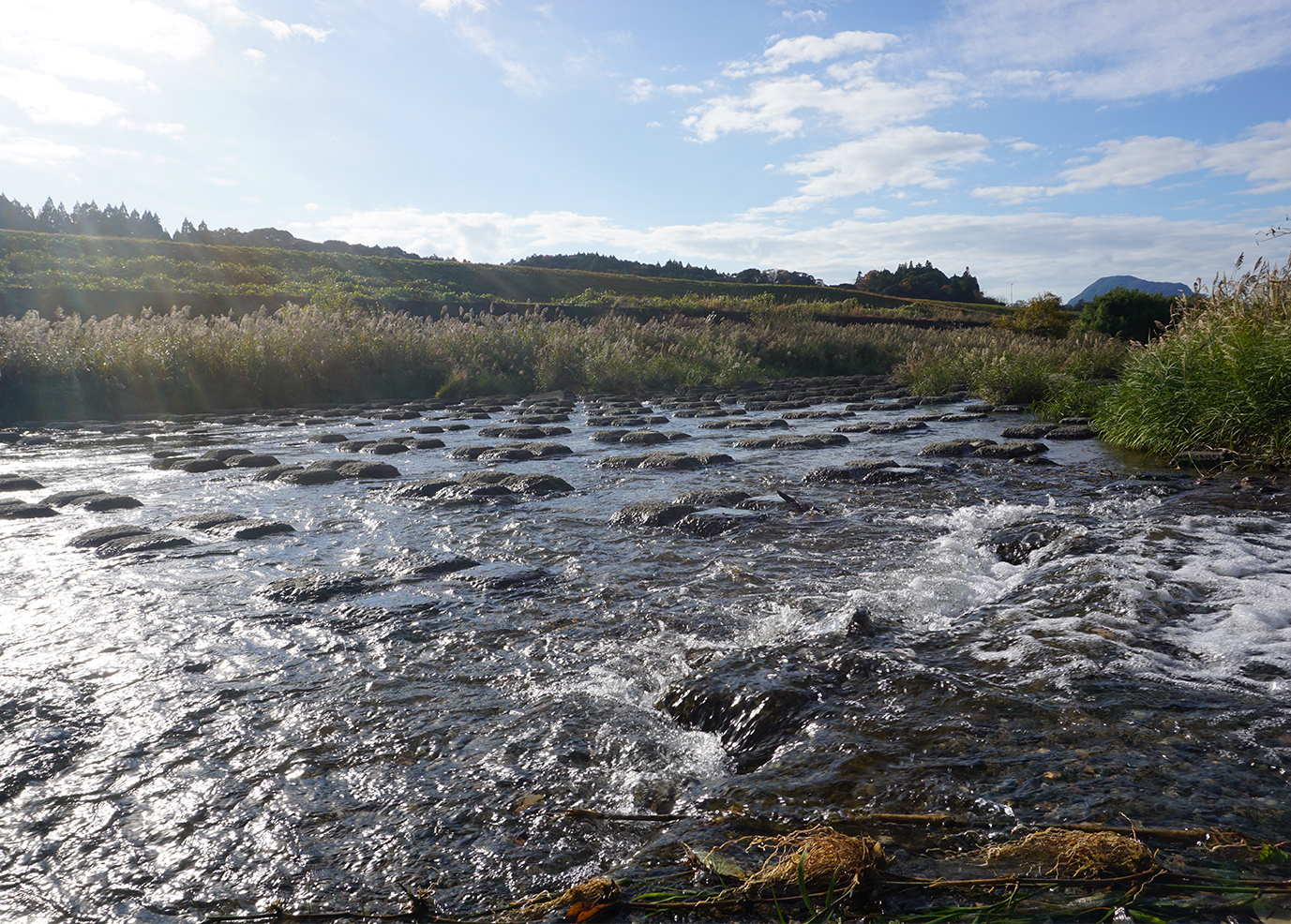
The integrated model we build in 2026|Small hydropower × wildlife-damage control × biodiversity
In semi-mountainous places like Yokomakura, damage by wild boar and other animals is severe, eroding farmland, the satoyama ecosystem and the very foundation of farming. At the same time, where electricity is hard to secure in the hills, the cost of installing and maintaining electric fencing over a wide area is a major barrier.
So we are building an integrated model in which small-scale hydropower — the satoyama's own renewable energy — reliably powers electric fencing, advancing wildlife-damage control, ecosystem recovery and farmland conservation at the same time. Electric fencing × small hydropower × biodiversity monitoring × community-based satoyama management are carried out as one, reconciling decarbonization with biodiversity conservation.
This work is supported by the Japan Fund for Global Environment, administered by the Environmental Restoration and Conservation Agency (ERCA), and will run in fiscal 2026 as a "regional renewable-energy model project for wildlife-damage control and satoyama conservation". We will document survey methods, equipment specifications and maintenance procedures, and record and publish them as a model that can be reproduced by municipalities, NPOs and rural communities.
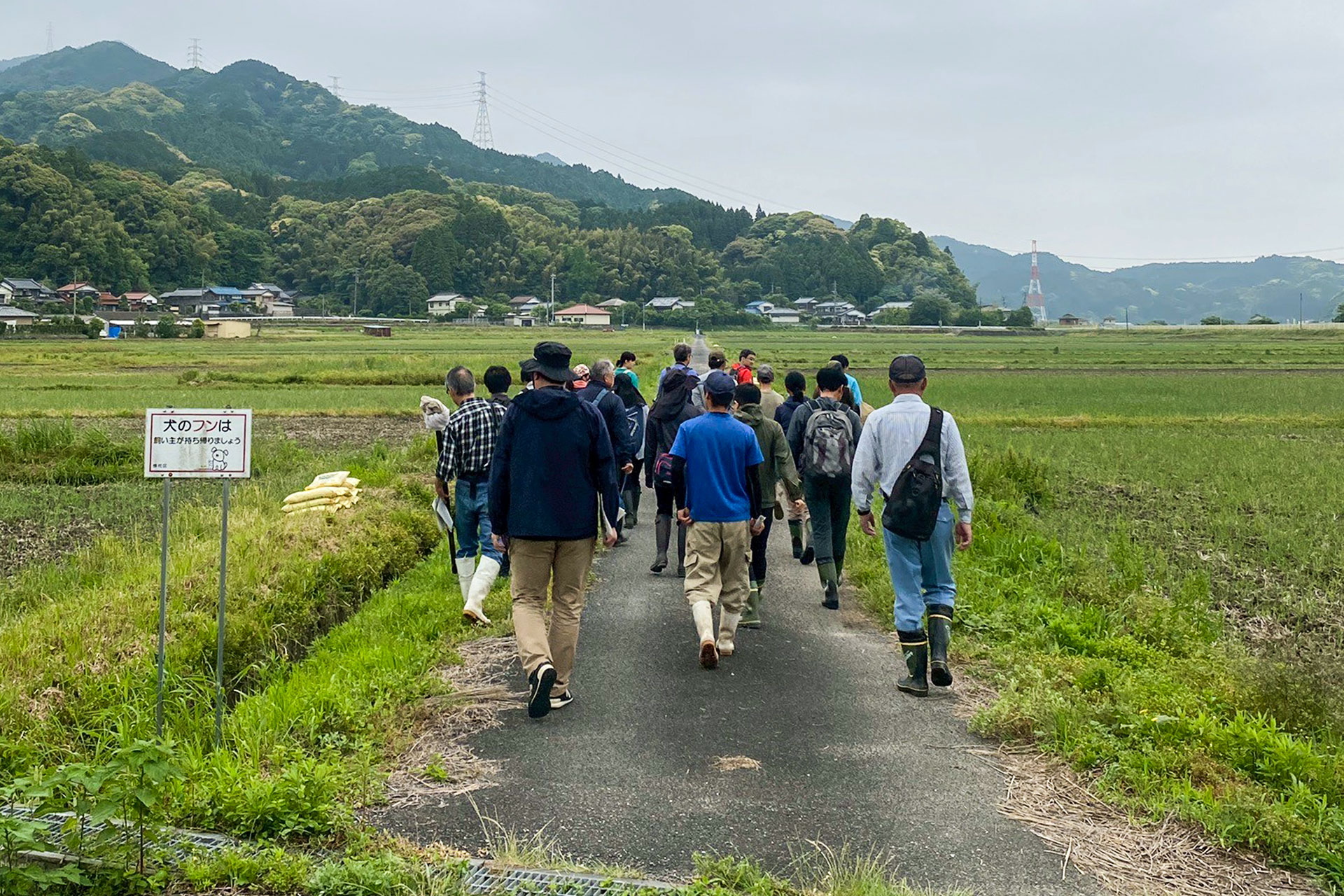
Science-based monitoring|In partnership with Professor Tokuda, Saga University
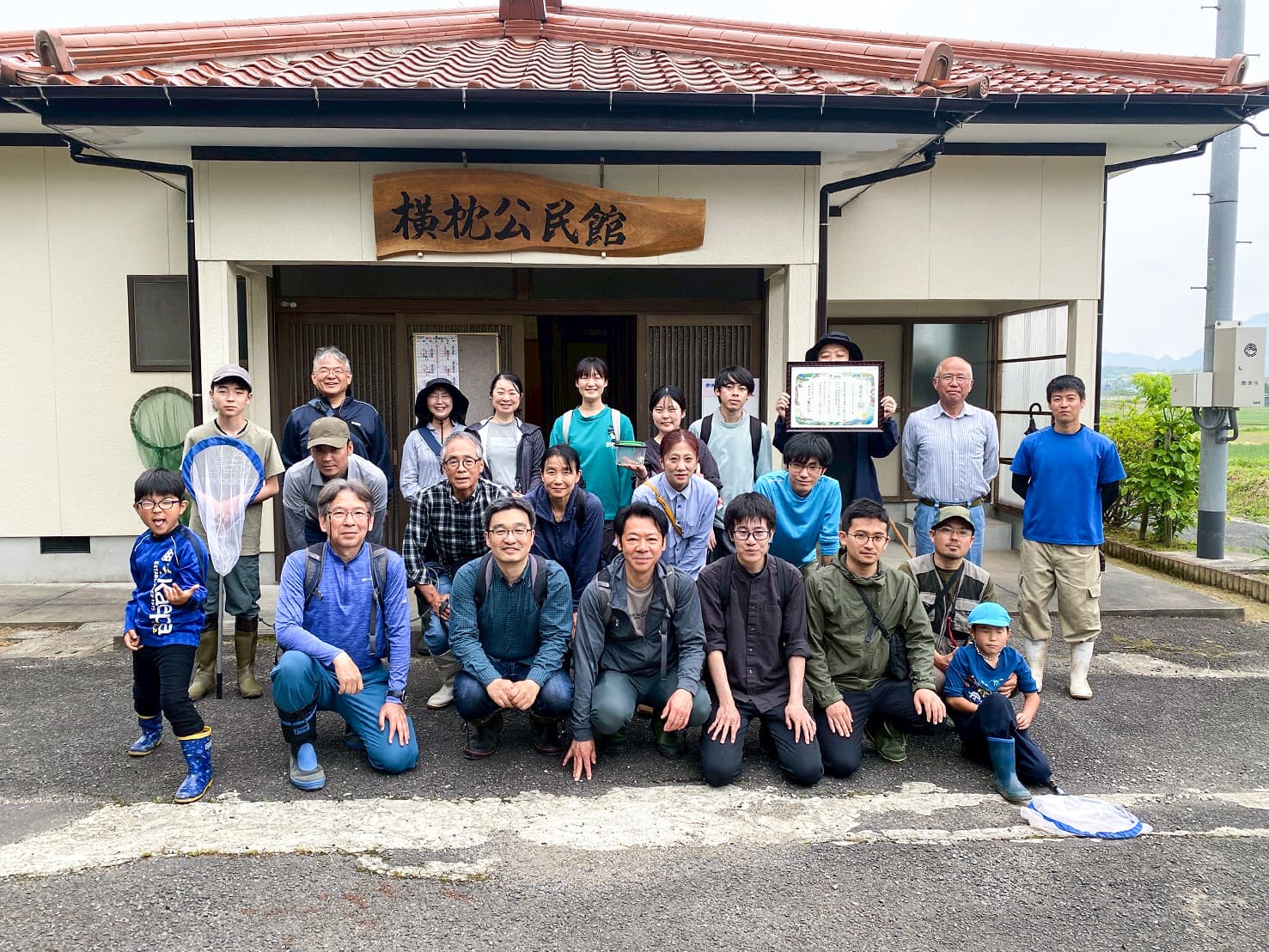
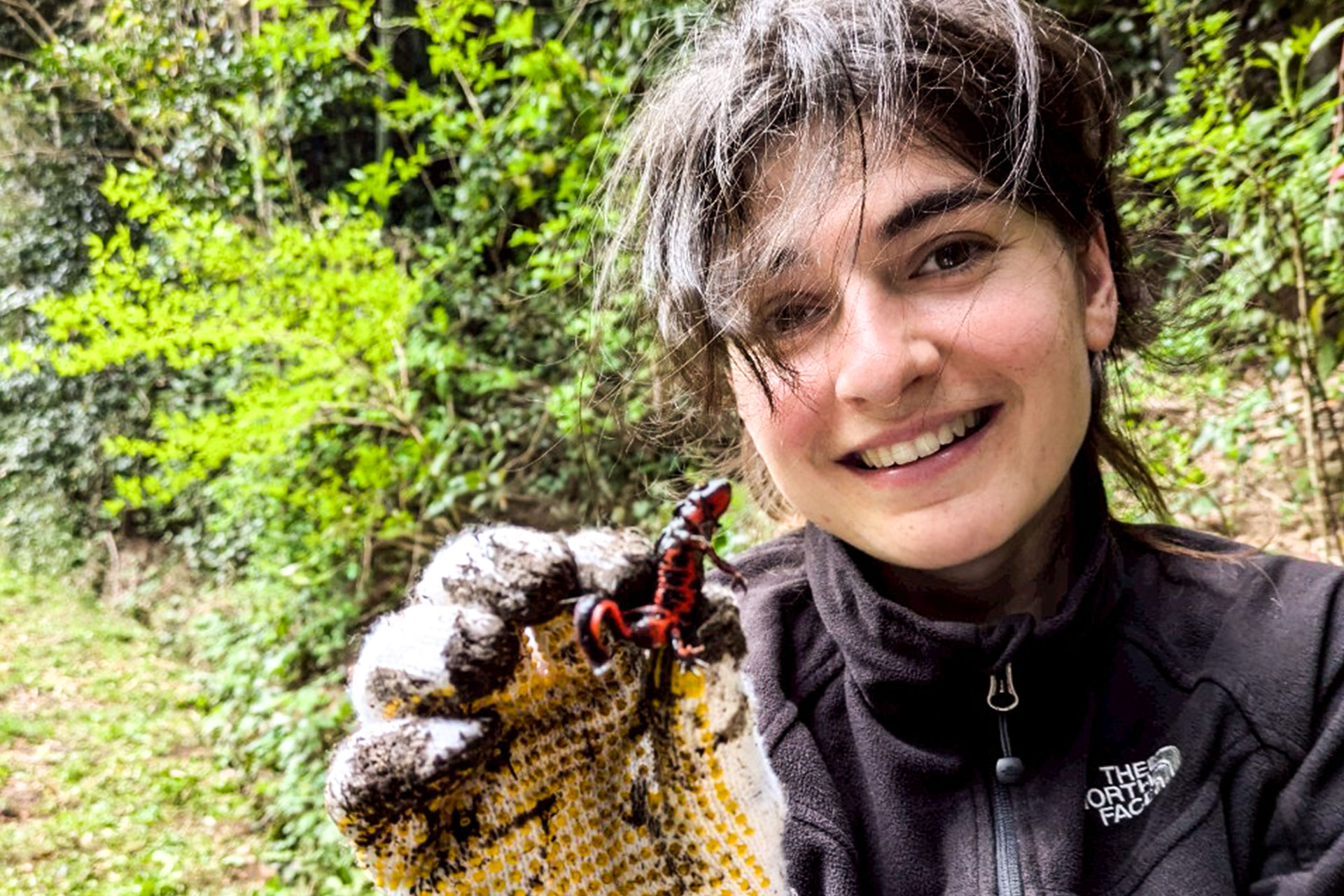
The foundation of the model is continuous biodiversity monitoring. At Yokomakura, working with experts including Professor Tokuda of the Faculty of Agriculture, Saga University, we record indicator species such as the Japanese clawed salamander and changes in vegetation. Local residents, high-school and university students, and overseas volunteers all take part, building a survey system that anyone can join.
Accumulating scientifically grounded data is what lets us measure the effect of conservation — and gives us a common language for taking those results to other regions.
Connected to the world|Yokomakura's nature-positive
Yokomakura is the first community in Japan within Ecosystem Restoration Communities (ERC), a global ecosystem-restoration movement. Volunteers from France have stayed here to join in restoring the satoyama — a small satoyama connected directly to the world.
Karatsu Farm & Food has also joined the G7 Alliance on Nature Positive Economies (G7ANPE), an international alliance established at the G7 Ministers' Meeting on Climate, Energy and Environment in Sapporo in April 2023 as a forum for sharing knowledge and building information networks on nature-positive economies. Its members include businesses, economic organizations, NPOs and NGOs working on the connection between biodiversity and the economy.
Through "Nature Positive Christmas" with Daimaru Fukuoka Tenjin (in cooperation), we share the value of Kyushu's OECM sites with Asia and the world alongside the multinational students of Ritsumeikan Asia Pacific University (APU). From tackling marine plastic in Tsushima to communicating at Expo 2025 Osaka, Kansai, the circle keeps widening from Kyushu to Asia and the world.
On 14–16 July 2026, Kumamoto (Kumamoto-Jo Hall) hosts the second Global Nature Positive Summit (GNPS 2026), organized by the Nature Positive Initiative, following the first summit in Sydney in 2024 — an international gathering of nature-positive practice from around the world. As Kyushu draws global attention this summer, we continue to build Kyushu-born nature-positive practice from Yokomakura, Saga's first OECM site.
Our Karatsu Honeybee Project at Yokomakura is registered in the National Partnership Program of GREEN×EXPO 2027 (the 2027 International Horticultural Expo), to be held in Yokohama.
▶ Nature Positive · the Yokomakura OECM site
▶ G7ANPE — members (Ministry of the Environment, Japan)
Looking ahead|Taking the Yokomakura model to other regions
We intend to spread the model we are establishing at Yokomakura — renewable energy × wildlife-damage control × biodiversity × community participation — to other OECM sites and satoyama, while respecting each region's natural conditions and culture. Working hand in hand with local governments, companies and communities, we advance implementation and communication at the same time.
This work stands on a decade of practice. As of April 2026, our programs have welcomed 25,971 cumulative participants, including 2,589 in biodiversity conservation activities and 6,587 in environmental education — the community base that makes a reproducible, locally rooted model possible.
Building regions that live alongside nature — we will carry this practice of a Nature-Positive Economy from Kyushu to Asia and the world.
What we offer|Consulting, site visits and implementation support
Drawing on our hands-on experience at Yokomakura, we support organizations that want to put Green Infrastructure and nature-positive approaches to work:
- Green Infrastructure consulting — applying the Yokomakura integrated model (small hydropower × electric fencing × biodiversity) to your region
- On-site visits at a certified OECM site — usable as TNFD supplier-visit / ESG disclosure evidence
- Biodiversity monitoring design — survey protocols developed with Saga University researchers
- Implementation support for municipalities, NPOs and communities — documented methods, equipment specifications and maintenance procedures
FAQ
Q1. What is the Green Infrastructure model at Yokomakura?
It is an integrated model built in fiscal 2026 at the Yokomakura site, Saga Prefecture's first Ministry of the Environment–certified OECM site. Small-scale hydropower from the satoyama's own stream reliably powers electric fencing for wildlife-damage control, while biodiversity monitoring and community-based satoyama management run alongside it. The work is supported by the Japan Fund for Global Environment (ERCA), and the survey methods, equipment specifications and maintenance procedures are documented so that other regions can reproduce the model.
Q2. Can companies or municipalities visit the site?
Yes. We host on-site visits at the Yokomakura OECM site for companies, municipalities and institutions. For companies pursuing nature-related disclosure, a visit can serve as TNFD supplier-visit or ESG evidence, and visits can be combined with our regenerative-tourism and Precious Plastic programs in Kyushu. You can contact us in English at kojima@karatsu-f-f.com.
Q3. Can the model be implemented in other regions?
Yes — that is the model's purpose. We record and publish the survey methods, equipment specifications and maintenance procedures so that municipalities, NPOs and rural communities can adapt the model to their own natural conditions and culture. We also provide consulting and implementation support, drawing on our hands-on experience at Yokomakura and our monitoring partnership with Saga University.
If you are interested
If you are a local government, company, organization or educational institution interested in our work at Yokomakura, or in Green Infrastructure and OECM-site practice — or if you would like to work with us — please get in touch through the contact form below. We will gladly discuss possibilities tailored to your interests and local circumstances. You can also reach us in English at kojima@karatsu-f-f.com.
▶ Nature Positive — Saga's first OECM site
▶ Regenerative tourism & corporate study visits
▶ Precious Plastic Karatsu — Japan's hub for plastic upcycling
▶ Education for Sustainable Development (ESD)
About the organization
Karatsu Farm & Food
A non-profit based in Karatsu City, Saga Prefecture, Japan, working on ocean-plastic solutions, the circular economy, environmental education (ESD) and the management of a certified OECM site. As the manager of Saga's first OECM-registered site at Yokomakura and Japan's first Ecosystem Restoration Communities site, we are building a reproducible Green Infrastructure model and a Nature-Positive Economy — connecting a small satoyama to the world. Think Locally, Act Globally.