
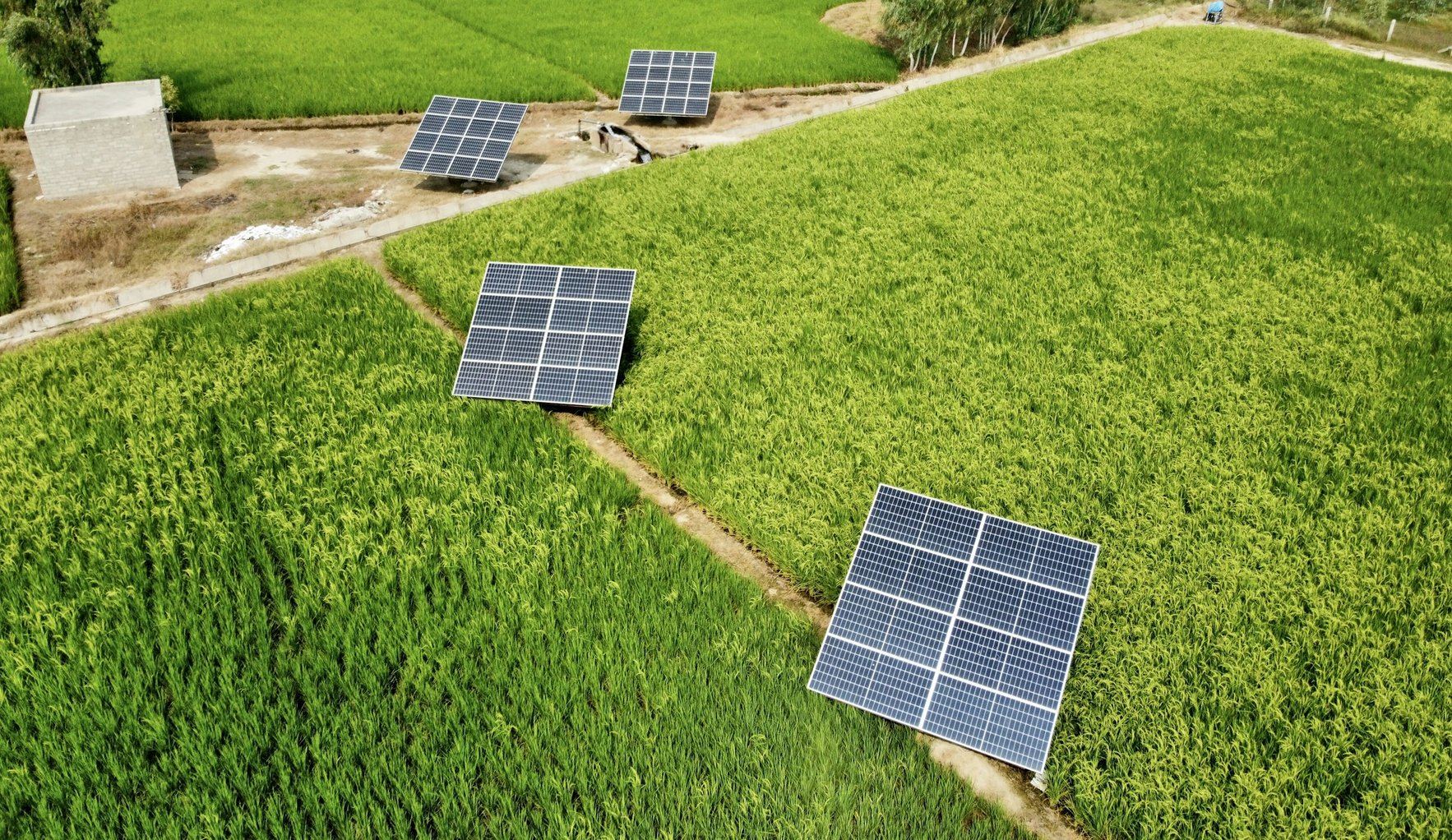
Agrivoltaics (solar sharing) in Japan in numbers
Agrivoltaics, known in Japan as solar sharing, places solar panels on posts above farmland while farming continues below. According to Japan's Ministry of Agriculture, Forestry and Fisheries (MAFF), farming on the land below was impeded at 24% of installations (1,221) at the end of FY2023, up 2 points from 22% a year earlier (MAFF, Status of agrivoltaic installations (end of FY2023, Japanese) p.6). The government's December 2025 package says it will promote projects compatible with farming "in a way that contributes to regional revitalisation" and will "respond strictly" to inappropriate ones (MAFF briefing (April 2026, Japanese) p.1).
This page is part of the Karatsu Data Bank by Karatsu Farm & Food. It sets out permit numbers and trends, the share and causes of impeded farming, crops grown below, changes in national rules and the draft conditions for "desirable" agrivoltaics, and rules and research abroad, from the world to Japan, Saga and Karatsu. Official wording on promotion and figures on problems are both given with sources. We add no conclusions or evaluative words. Rankings are our own ordering. Solar panel waste is on solar panel waste.
| Rank | Prefecture | Permits (cumulative) | of which FY2023 | (Ref.) re-permits (cumulative) |
|---|---|---|---|---|
| 1 | Chiba | 702 | 23 | 685 |
| 2 | Shizuoka | 679 | 68 | 443 |
| 3 | Gunma | 521 | 31 | 438 |
| 4 | Ibaraki | 428 | 62 | 269 |
| 5 | Fukushima | 418 | 83 | 137 |
| 6 | Miyagi | 306 | 41 | 92 |
| 7 | Tokushima | 280 | 10 | 143 |
| 8 | Aichi | 276 | 80 | 109 |
| 9 | Yamanashi | 214 | 25 | 152 |
| 10 | Tochigi | 210 | 42 | 45 |
| 38 | Saga | 20 | 0 | 11 |
| Japan | 6,137 | 791 | 4,238 |
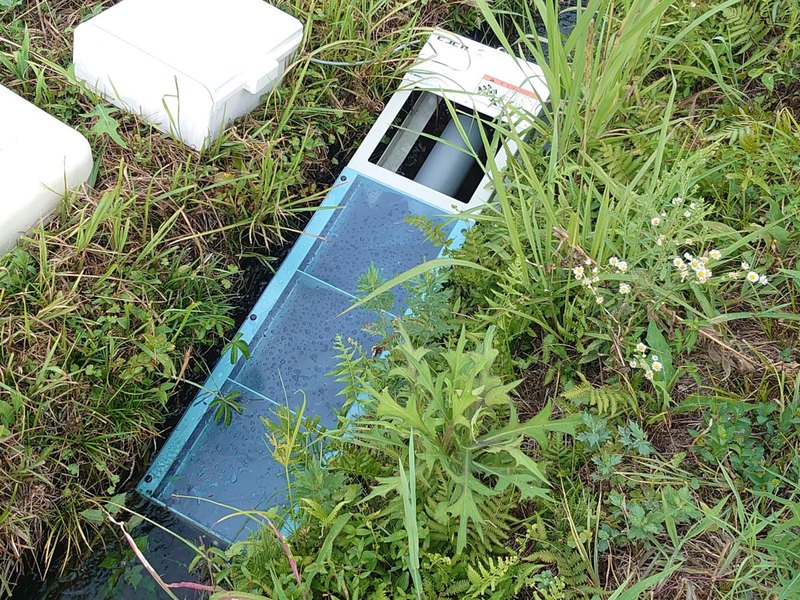
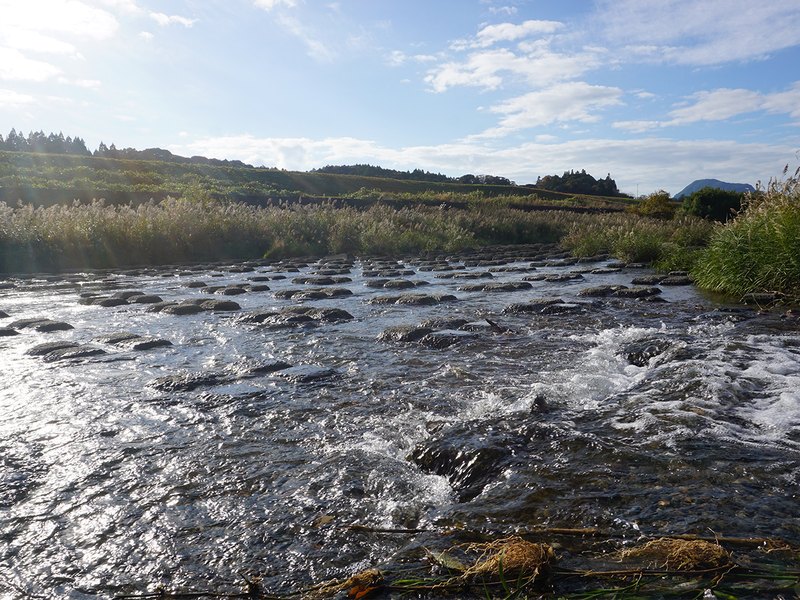
On 7 October 2026, at Yokomakura in Ochi, Karatsu, we installed a small hydropower generator driven by the flow of a water channel. It sends power through a battery to an electric fence against wildlife damage.
See our work
To cite this data or to ask about site visits, training or corporate partnerships on small hydropower and wildlife damage control at Yokomakura.
Contact page
Worldwide: rules and research abroad (2024-2026)
| Country | Rules and figures | Source |
|---|---|---|
| France | Decree 2024-318 (8 April 2024): yield must exceed 90% of the control average (the prefect may lower this in exceptions); installations over 10 MWc are limited to 40% panel cover (proven technologies are capped by a separate order) | Légifrance |
| Germany | 95 installations, about 390 MWp and 1,210 ha in a university database (June 2025). A special support category under the Renewable Energy Act (EEG) since 2023; the separate cap and bonus added in the May 2024 amendment had not received EU state-aid approval as of May 2026 | Bundestag research service WD 5-059/26 |
| Republic of Korea | Act on the promotion and support of agrivoltaic power projects (promulgated 16 June 2026, in force 17 December 2026). Under the draft enforcement decree, the project period is up to 23 years (5 years plus six 3-year extensions); the draft also sets procedures for sharing revenue with residents and for restoration | MAFRA notice 2026-487 |
France's summary of public comments on the draft decree records comments asking for a 20% yield-loss allowance and citing a research institute's recommendation of 20% cover (French government). A German research institute estimates the potential on suitable land at 500 to 800 GWp (Fraunhofer ISE 2025).
A 2026 review finds that outcomes of open-field agrivoltaics depend strongly on conditions and design (AgriEngineering 8(2):69). A 2025 review notes that the microclimate under panels may affect pollinators, natural enemies, pests, pathogens and invasive species, and that research on biodiversity is still limited (Biological Reviews 100(2)).
Japan: permits over time (FY2013-FY2023)
| Fiscal year | New permits | Farmland below (ha) | Re-permits |
|---|---|---|---|
| FY2013 | 103 | 16.3 | - |
| FY2014 | 311 | 53.5 | - |
| FY2015 | 378 | 85.3 | 4 |
| FY2016 | 414 | 161.2 | 95 |
| FY2017 | 318 | 79.9 | 351 |
| FY2018 | 475 | 151.4 | 339 |
| FY2019 | 640 | 166.0 | 396 |
| FY2020 | 807 | 132.2 | 629 |
| FY2021 | 880 | 141.9 | 664 |
| FY2022 | 1,020 | 231.9 | 808 |
| FY2023 | 791 | 141.8 | 952 |
| Total | 6,137 | 1,361.6 | 4,238 |
Problems: share of installations where farming is impeded (end of FY2023, 24%)
| Cause | Cases | Share |
|---|---|---|
| Lower yield or poor growth (attributable to the farmer) | 872 | 71% |
| Delays in installation works | 144 | 12% |
| Lower yield or poor growth (disasters etc.) | 87 | 7% |
| Other | 118 | 10% |
| Total impeded | 1,221 | 100% |
MAFF states that it is instructing permit authorities to take corrective measures where lower yield or poor growth is attributable to the farmer (MAFF, Status of agrivoltaic installations (end of FY2023, Japanese) p.6). Farmers on the land below are 42% (2,483) designated core farmers and 58% (3,470) others; for permits issued in FY2023, core farmers were 63% (497) (p.5).
Crops grown under the panels (end of FY2023)
| Rank | Crop | Cases | Share |
|---|---|---|---|
| 1 | Sakaki and shikimi (ornamental) | 1,901 | 32% |
| 2 | Vegetables (komatsuna, Chinese cabbage, leek, squash, potatoes, etc.) | 961 | 16% |
| 3 | Fruit (citrus, blueberry, persimmon, grape) | 791 | 13% |
| 4 | Rice, wheat, soybeans, buckwheat | 541 | 9% |
| 5 | Myoga ginger | 374 | 6% |
| 6 | Shiitake and wood ear mushrooms | 340 | 6% |
| 7 | Butterbur, udo, ashitaba, bracken, dokudami, red clover | 319 | 5% |
| 8 | Italian ryegrass, sorghum, Chinese milk vetch (forage) | 247 | 4% |
| 9 | Senryo, mahonia, tamaryu | 246 | 4% |
| 10 | Tea | 213 | 4% |
Changes in national rules (2018-2026)
| Date | Event | Source |
|---|---|---|
| May 2018 | Temporary conversion period extended from 3 to 10 years where core farmers farm the land below | MAFF p.5 |
| April 2024 | Permit criteria raised to the Cropland Act enforcement regulations (no risk of yields falling by roughly 20% or more against the local average, etc.), guidelines issued, and suspension of FIT/FIP payments introduced under the amended renewable energy act | MAFF briefing p.1 |
| 5 August 2024 | FIT/FIP payments suspended for 15 cases (6 operators) where farming was not properly continued or equipment was not removed after the permit expired | MAFF document 2 (March 2026), p.5 |
| 25 November 2024 | Same suspension for 14 cases (7 operators) not removed after expiry or installed without a permit | same, p.5 |
| April 2025 | Cropland Act amended | MAFF briefing p.1 |
| 23 December 2025 | Mega-solar countermeasures package (ministerial meeting) includes "clarifying desirable agrivoltaics and responding strictly to inappropriate cases" | MAFF briefing p.1 |
| 15 April 2026 | Sixth meeting of the study group on desirable agrivoltaics: approach and direction of rule changes presented | summary |
Draft conditions for "desirable" agrivoltaics (April 2026)
MAFF proposes to write its approach to desirable agrivoltaics into the basic policy under the act on renewable energy in rural areas, so that local governments can judge projects against it. The basic idea: temporary conversion is allowed as an exception on the premise that proper farming continues; farmland keeps its function as a base for food production; projects contribute to farmers' incomes and business development; and they coexist with and revitalise the region (MAFF briefing (April 2026, Japanese) pp.2-3). All of the following are drafts.
| Item | Draft condition |
|---|---|
| Equipment | Shading rate under 30% (where hard to judge, sunlight reduced by under 20% at every point of the field through the growing season) |
| Equipment | Minimum clearance about 3 m or more; post spacing about 4 m or more in the direction of farm machinery |
| Farming | Farmer named in the local agricultural plan as a future farmer; production or sales of JPY 500,000 or more in the crop |
| Crops | Crops commonly grown and sold locally, harvestable every year in principle. Rice, wheat and soybeans are said to be able to secure the required yield under shading with proper management |
| Coexistence | Agreement in local consultation, fair profit sharing from the power producer to farmers, insurance for third-party damage, secured removal costs |
| Existing projects | Threshold for national review and site inspections lowered from over 4 ha to 2 ha; no re-permit if no improvement after a recommendation; shorter re-permit periods |
Saga Prefecture and Karatsu
Saga Prefecture had 20 agrivoltaic permits in total (March 2024), 38th of 47 prefectures, tied with Oita. None were newly permitted in FY2023; re-permits totalled 11 (2 in FY2023) (MAFF, Permits for agrivoltaic installations by prefecture (as of March 2024, Japanese)). National data are by prefecture only; we found no figure for Karatsu City in the public sources checked.
An example from Karatsu: small hydropower and an electric fence at Yokomakura (our work)
On 7 October 2026, at Yokomakura in Ochi, Karatsu, we installed a small hydropower generator driven by the flow of a water channel; it sends power through a battery to an electric fence against wildlife damage (Green Infrastructure). We do not operate agrivoltaics, so this page has no measurements of our own.
Frequently asked questions
Q1. What is agrivoltaics (solar sharing)?
Solar equipment placed on simple, easily removable posts above farmland under a temporary, exceptional land-use conversion, while farming continues below (MAFF briefing (April 2026, Japanese) p.3).
Q2. What are the problems with agrivoltaics in Japan?
At the end of FY2023, farming on the land below was impeded at 24% of installations (1,221); 71% of these were lower yield or poor growth attributable to the farmer (MAFF, Status of agrivoltaic installations (end of FY2023, Japanese) p.6). In 2024, FIT/FIP payments were suspended for projects where farming had not continued or equipment had not been removed (MAFF material).
Q3. How many agrivoltaic permits are there in Japan?
6,137 new permits from FY2013 to FY2023, covering 1,361.6 ha. The peak year was FY2022 with 1,020; FY2023 had 791 (MAFF, Status of agrivoltaic installations (end of FY2023, Japanese) p.2).
Q4. Which prefectures have the most agrivoltaics?
Chiba (702), Shizuoka (679) and Gunma (521), as of March 2024 (MAFF, Permits for agrivoltaic installations by prefecture (as of March 2024, Japanese)).
Q5. Is the Japanese government promoting agrivoltaics?
The December 2025 package says it will clarify desirable projects compatible with farming and promote them with local government involvement in a way that contributes to regional revitalisation, while responding strictly to inappropriate cases (MAFF briefing (April 2026, Japanese) p.1).
Sources
| Source | Publisher | Date | URL | Accessed |
|---|---|---|---|---|
| Status of agrivoltaic installations (end of FY2023) (Japanese) | MAFF | 2025-12 | https://www.maff.go.jp/j/nousin/noukei/totiriyo/attach/pdf/einogata-64.pdf | 2026-11-26 |
| Permits for agrivoltaic installations by prefecture (as of March 2024) (Japanese) | MAFF | as of 2024-03 | https://www.maff.go.jp/j/nousin/noukei/totiriyo/attach/pdf/einogata-62.pdf | 2026-11-26 |
| Agrivoltaics (Japanese) | MAFF | - | https://www.maff.go.jp/j/nousin/noukei/totiriyo/einogata.html | 2026-11-26 |
| Study group on desirable agrivoltaics, MAFF briefing (Japanese) | MAFF | 2026-04 | https://www.maff.go.jp/j/study/attach/pdf/250609-26.pdf | 2026-11-26 |
| Agrivoltaics, document 1, p.1 on tightened rules (Japanese) | MAFF | 2026-01 | https://www.maff.go.jp/j/study/attach/pdf/250609-22.pdf | 2026-11-26 |
| Study group, 6th meeting summary (Japanese) | MAFF | 2026-04-15 | https://www.maff.go.jp/j/study/attach/pdf/250609-28.pdf | 2026-11-26 |
| Clarifying desirable agrivoltaics, document 2, p.5 on FIT/FIP suspensions (Japanese) | MAFF (posted on the Ministry of the Environment site) | 2026-03 | https://www.env.go.jp/content/000388043.pdf | 2026-11-26 |
| Mega-solar countermeasures package (draft, ministerial meeting material) (Japanese) | Cabinet Secretariat | 2025-12 | https://www.cas.go.jp/jp/seisaku/megasolar/dai1/shiryo2.pdf | 2026-11-26 |
| Décret n° 2024-318 | French government (Légifrance) | 2024-04-08 | https://www.legifrance.gouv.fr/jorf/id/JORFSCTA000049386046 | 2026-11-26 |
| Summary of public comments on the draft decree (French) | French Ministry for the Ecological Transition | 2024-04-05 | https://www.consultations-publiques.developpement-durable.gouv.fr/IMG/pdf/synthese_des_observations_du_public-12.pdf | 2026-11-26 |
| WD 5-059/26, Regulierung und Förderung von Agri-PV im europäischen Vergleich (German) | German Bundestag research service | 2026 | https://www.bundestag.de/resource/blob/1198072/WD-5-059-26.pdf | 2026-11-26 |
| Spatial potential analysis and site selection for agrivoltaics in Germany (RSER 213) | Fraunhofer ISE et al. | 2025 | https://publica.fraunhofer.de/handle/publica/489029 | 2026-11-26 |
| MAFRA notice 2026-487 (Korean) | Korea Ministry of Agriculture, Food and Rural Affairs | 2026 | https://mafra.go.kr/bbs/home/788/600614/download.do | 2026-11-26 |
| MAFRA notice 2026-488, draft enforcement rules (Korean) | Korea Ministry of Agriculture, Food and Rural Affairs | 2026 | https://mafra.go.kr/bbs/home/788/600620/download.do | 2026-11-26 |
| Review of open-field agrivoltaics (AgriEngineering 8(2):69) | MDPI | 2026-02 | https://www.mdpi.com/2624-7402/8/2/69 | 2026-11-26 |
| Review of agrivoltaics and biodiversity (Biological Reviews 100(2)) | Wiley | 2025 | https://www.ncbi.nlm.nih.gov/pmc/articles/PMC11885692/ | 2026-11-26 |
Where sources differ
Denominators differ within the same MAFF document: 6,137 is the total of new permits since FY2013; 5,953 (farmers and crops) is installations existing at the end of FY2023; 5,167 (impeded farming) is existing installations excluding those newly permitted in FY2023 (MAFF, Status of agrivoltaic installations (end of FY2023, Japanese) pp.5-7).
Not covered on this page
Power output, sales income, individual projects and landscape are not covered. Solar panel waste is on solar panel waste, offshore wind on offshore wind, small hydropower on small hydropower.
Citing this page and enquiries
To cite these figures, or to ask about visits, training or partnerships on small hydropower and wildlife damage control at Yokomakura, use our contact page or info@karatsu-f-f.com.
About this page
Publisher: Karatsu Farm & Food / Reviewed and approved by Hiroaki Kojima (Vice Director) / Contact: info@karatsu-f-f.com (contact page) / Published 26 November 2026 / Markdown: agrivoltaics-data.mdThis page is made together with AI. See this data bank and AI for how.
Related links
▶ Karatsu Data Bank
▶ Solar panel waste
▶ IPBES and renewable energy
▶ Offshore wind
▶ Small hydropower
▶ Abandoned farmland
▶ Green Infrastructure
▶ 営農型太陽光発電(ソーラーシェアリング)のデータ(日本語)