
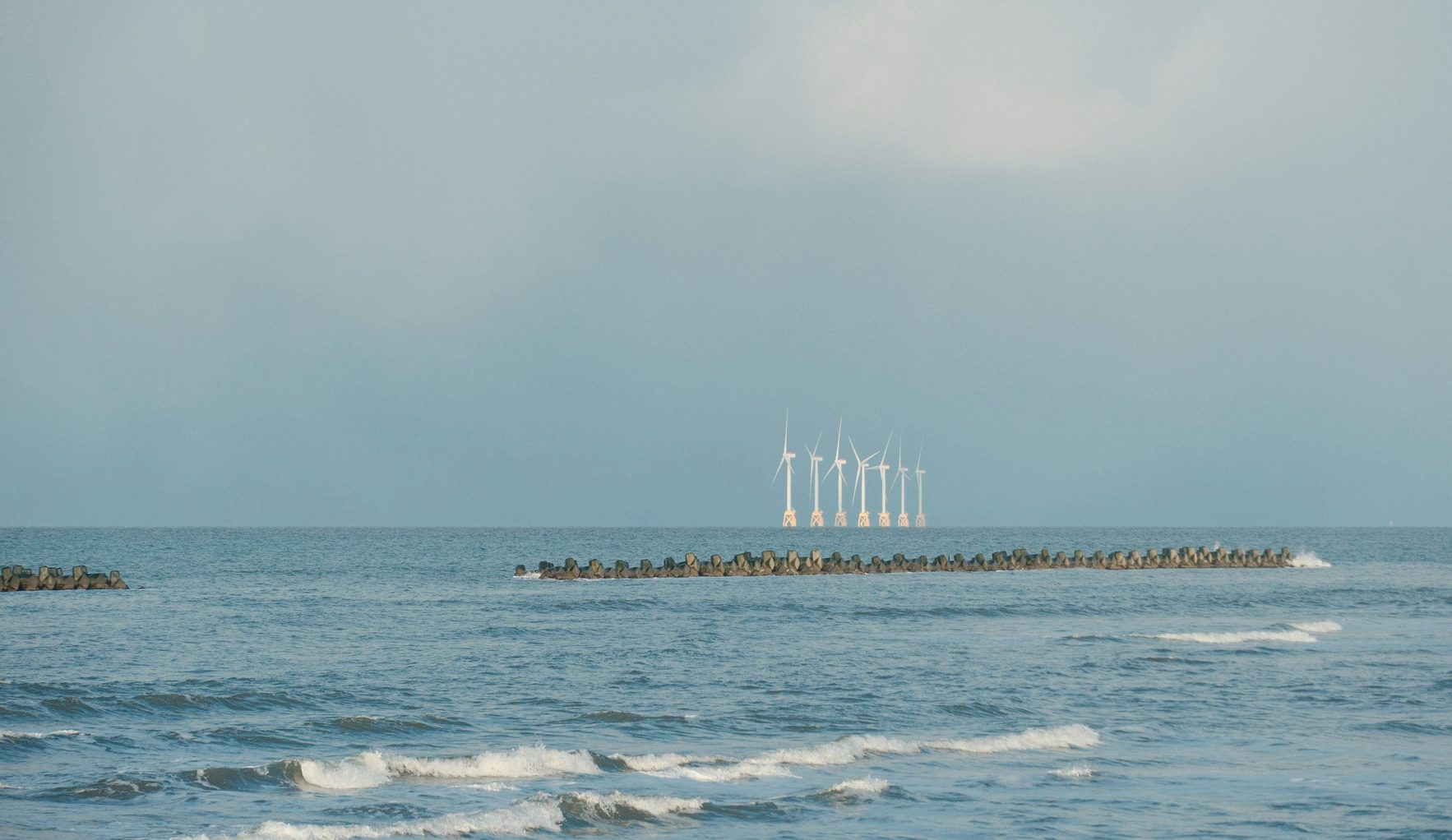
What are the disadvantages and problems of offshore wind power?
A Ministry of the Environment study group report (March 2023) lists noise, turbidity, birds, marine mammals, fish, benthic animals, seaweeds and seagrasses, and landscape among the items assessed for fixed-bottom offshore wind, and names noise, birds and marine life as items of particular concern in the Environment Minister's opinions (Ministry of the Environment, report of the FY2022 study group on environmental impact assessment for offshore wind, p. 5). In Japan, Mitsubishi Corporation, which led the consortium selected for three Round 1 sites, announced on 27 August 2025 that it would stop developing them (ANRE, Offshore wind power, Oct 2025, p. 2), delaying about 1.7 GW of capacity (Agency for Natural Resources and Energy (ANRE), Offshore wind power, 26 Dec 2025, p. 16). Global offshore wind capacity reached 92.5 GW at the end of 2025, 52.3% of it in China (GWEC, Global Offshore Wind Report 2026).
This page was made by Karatsu Farm & Food as part of the Karatsu Data Bank. It sets out offshore wind power and its disadvantages and problems using figures and statements from public sources: the world (ranking and trend by country), Japan (zones by prefecture, selections by round, plants in operation, environmental impact assessment, birds, fisheries, decommissioning, withdrawal and generation cost), Saga and Karatsu. A review of research on ecological impacts, the history of the waters off Karatsu and Saga Prefecture's Q&A are on Renewable energy and biodiversity (the IPBES Nexus Assessment and Karatsu).
| Question | Figure | Period | Source |
|---|---|---|---|
| Global cumulative capacity | 92.5 GW | end of 2025 | GWEC p. 35 |
| New global capacity in 2025 | 9.3 GW | 2025 | GWEC p. 35 |
| Largest market | China 52.3% (48.4 GW) | end of 2025 | GWEC pp. 36, 38 |
| Japan's cumulative capacity | 0.3 GW | end of 2025 | GWEC p. 38 |
| Japan's zones | 12 promotion, 9 promising, 17 preparatory | as of 5 Jan 2026 | ANRE |
| Decommissioning cost at tender stage | 70% of offshore construction cost | Round 3 tender guidelines | METI and MLIT |
| Sea eagle collisions with wind turbines (incl. onshore) | 73 | FY2003-FY2021 | Ministry of the Environment |
| Generation cost of fixed-bottom offshore wind | ¥30.9/kWh (2023), ¥14.0/kWh (2040, base case) | incl. policy costs | Generation cost working group |
Offshore wind capacity by country (end of 2025)
GWEC reports that 9.3 GW of new offshore wind was grid-connected worldwide in 2025, 16% more than the year before, bringing the total to 92.5 GW, or 7.1% of all wind capacity. Asia Pacific had 53.5 GW (58% of the world), Europe over 38 GW (42%) and North America 174 MW, all in the United States (GWEC 2026, pp. 35, 38). Floating wind totalled 278 MW (5 MW in Japan), and 2025 was the first year since 2015 with no new floating capacity (p. 39).
| Rank | Country/region | Share of cumulative (end 2025) | Cumulative (GW) | Share of cumulative (end 2024) |
|---|---|---|---|---|
| 1 | China | 52.3% | 48.4 | 50.3% |
| 2 | United Kingdom | 18.4% | about 17.0 | 19.2% |
| 3 | Germany | 10.4% | about 9.6 | 10.9% |
| 4 | Netherlands | 5.3% | about 4.9 | 5.9% |
| 5 | Taiwan | 3.9% | 3.6 | 3.7% |
| 6 | Denmark | 2.9% | about 2.7 | 3.2% |
| 7 | Belgium | 2.4% | about 2.2 | 2.7% |
| 8 | France | 2.1% | about 1.9 | 1.8% |
| 9 | Vietnam | 0.9% | 0.9 | 1.1% |
| Others (incl. Japan, South Korea, US) | 1.2% | about 1.1 | 1.2% | |
| (of which Japan) | - | 0.3 | - | |
| (of which South Korea) | - | 0.3 | - | |
| World | 100% | 92.5 | 100% (83.2 GW) |
Global cumulative offshore wind capacity, 2024-2025
| Year end | World cumulative (GW) | New that year (GW) | China cumulative (GW) | Source |
|---|---|---|---|---|
| End 2024 | 83.2 | 8 | 41.8 | GWEC 2025 |
| End 2025 | 92.5 | 9.3 | 48.4 | GWEC 2026 |
Auction volumes vary widely. Auctions and allocations reached a record 56.3 GW in 2024 (GWEC 2025 p. 48), but 11.4 GW was awarded in 2025, one fifth of 2024 (GWEC 2026 p. 11). GWEC expects 420 GW by the end of 2035 (p. 8). The IEA cut its global offshore wind forecast by 27% from the previous year, citing undersubscribed auctions and cancelled projects in several European markets and Japan amid US policy changes, macroeconomic pressure and supply chain problems (IEA, Renewables 2025).
Japan's offshore wind zones by prefecture (as of 5 January 2026)
ANRE's list as of 5 January 2026 shows 38 zones under the Act on Promoting the Utilisation of Sea Areas for Renewable Energy (renamed from 1 April 2026): 12 promotion zones, 9 promising zones and 17 preparatory zones, in 15 prefectures (ANRE, designation status of promotion and promising zones; prefecture count our calculation). MLIT's map as of June 2026 shows the same numbers (MLIT, 100th Ports and Harbours Subcommittee, Document 5 p. 1).
| Prefecture | Promotion zones | Promising zones | Preparatory zones | Zones |
|---|---|---|---|---|
| Hokkaido | off Matsumae, off Hiyama | off Ishikari City, off Ganu and Minami-Shiribeshi, off Shimamaki | off Ganu and Minami-Shiribeshi (floating), off Shimamaki (floating) | 7 |
| Aomori | Sea of Japan (south) | Sea of Japan (north) | Mutsu Bay | 3 |
| Iwate | - | - | off Kuji City (floating) | 1 |
| Akita | off Noshiro, Mitane and Oga, off Yurihonjo City, off Happo and Noshiro, off Oga, Katagami and Akita | off Akita City | - | 5 |
| Yamagata | off Yuza Town | off Sakata City | - | 2 |
| Niigata | off Murakami and Tainai | - | - | 1 |
| Chiba | off Choshi City | off Kujukuri, off Isumi City | off Asahi City | 4 |
| Tokyo | - | - | off Oshima (floating), off Niijima (floating), off Kozushima (floating), off Miyake (floating), off Hachijo (floating) | 5 |
| Toyama | - | - | eastern waters (floating) | 1 |
| Fukui | - | - | off Awara City | 1 |
| Wakayama | - | - | offshore (east), offshore (west, floating) | 2 |
| Fukuoka | - | Hibikinada | - | 1 |
| Saga | - | - | off Karatsu City | 1 |
| Nagasaki | off Goto City (floating), off Enoshima, Saikai City | - | south of Goto City (floating) | 3 |
| Kagoshima | - | - | off Ichikikushikino City | 1 |
| Total (15 prefectures) | 12 zones | 9 zones | 17 zones | 38 |
On 8 October 2026, METI and MLIT announced that the state survey through JOGMEC (Japan Organization for Metals and Energy Security) would cover the waters off Wakayama (east) and off Ichikikushikino, Kagoshima, with an additional survey off Hiyama, Hokkaido (METI and MLIT).
Developers selected by round, 2021-2024
| Round | Zone | Capacity at selection (10 MW units) | Supply price (¥/kWh) | Planned start | Selected developers | Selected |
|---|---|---|---|---|---|---|
| Round 1 | off Goto, Nagasaki (floating) | 1.68 | 36 (FIT) | began operating Jan 2026 | Toda Corporation, ENEOS, Osaka Gas, INPEX, Kansai Electric Power, Chubu Electric Power | 2021-06-11 |
| Round 1 | off Noshiro, Mitane and Oga, Akita | 49.4 | 13.26 | Dec 2028 (withdrawn) | Mitsubishi Corporation Offshore Wind, Mitsubishi Corporation, C-Tech | 2021-12-24 |
| Round 1 | off Yurihonjo, Akita | 84.5 | 11.99 | Dec 2030 (withdrawn) | the same plus Wenty Japan | 2021-12-24 |
| Round 1 | off Choshi, Chiba | 40.3 | 16.49 | Sep 2028 (withdrawn) | Mitsubishi Corporation Offshore Wind, Mitsubishi Corporation, C-Tech | 2021-12-24 |
| Round 2 | off Happo and Noshiro, Akita | 37.5 | 3 | Jun 2029 | ENEOS Renewable Energy, Iberdrola, Tohoku Electric Power | 2024-03-22 |
| Round 2 | off Oga, Katagami and Akita, Akita | 31.5 | 3 | Jun 2028 | JERA, J-Power, Itochu, Tohoku Electric Power | 2023-12-13 |
| Round 2 | off Murakami and Tainai, Niigata | 68.4 | 3 | Jun 2029 | Mitsui & Co., RWE, Osaka Gas | 2023-12-13 |
| Round 2 | off Enoshima, Saikai, Nagasaki | 42.0 | 22.18 | Aug 2029 | Sumitomo Corporation, TEPCO Renewable Power | 2023-12-13 |
| Round 3 | Sea of Japan (south), Aomori | 61.5 | 3 | Jun 2030 | JERA, Green Power Investment, Tohoku Electric Power | - |
| Round 3 | off Yuza, Yamagata | 45.0 | 3 | Jun 2030 | Marubeni, Kansai Electric Power, BP, Tokyo Gas, Marutaka | - |
Offshore wind farms operating in Japan (2026)
| Wind farm | Location | Capacity | Turbines | Start of operation | Source |
|---|---|---|---|---|---|
| Kitakyushu Hibikinada Offshore Wind Farm | Port of Kitakyushu, Fukuoka | about 220,000 kW | 9.6 MW × 25 | 2 Mar 2026 | source |
| Ishikari Bay New Port Offshore Wind | Ishikari Bay New Port, Hokkaido | about 112,000 kW | 8 MW × 14 | 1 Jan 2024 | source |
| Noshiro Port Offshore Wind | Port of Noshiro, Akita | 84,000 kW | 4,200 kW × 20 | Dec 2022 | source |
| Akita Port Offshore Wind | Port of Akita, Akita | 54,600 kW | 4,200 kW × 13 | Jan 2023 | source |
| Goto Offshore Wind Farm (floating) | off Goto City, Nagasaki | about 16,800 kW (16.8 MW) | 2.1 MW × 8 | 5 Jan 2026 | source |
Offshore wind installed under the feed-in tariff and premium schemes (FIT/FIP) totalled 490,275 kW at the end of June 2026 (ANRE, FIT public information website, Table A2-1, new certifications).
Environmental impact assessment for offshore wind
Under the Environmental Impact Assessment Act, wind farms of 50,000 kW or more must go through assessment (Class 1) and those of 37,500 kW to under 50,000 kW are judged case by case (Class 2) (Ministry of the Environment, projects subject to EIA). These thresholds come from an amended Cabinet Order in force from October 2021 (Ministry of the Environment, sea eagle bird-strike guidance (revised)).
As of December 2022, offshore wind had 86 primary environmental impact consideration documents and 10 draft environmental impact statements in total (Ministry of the Environment, study group report p. 5). The 2026 Annual Report on the Environment states that 922 EIA procedures had been carried out for all project types by the end of March 2026, that wind farms are among the projects with the most reviews, and that their environmental impact depends more on location than on scale. As offshore wind has little operating record and post-operation knowledge is limited, the Environment Minister's opinions call for follow-up surveys and additional conservation measures, and METI and the Ministry of the Environment published monitoring guidelines for offshore wind farms in September 2025 (Ministry of the Environment, Annual Report on the Environment 2026).
| Item | Content | Source |
|---|---|---|
| Class 1 (assessment required) | 50,000 kW or more | MOE |
| Class 2 (case by case) | 37,500 kW to under 50,000 kW | MOE |
| Offshore wind: primary consideration documents | 86 (cumulative) | MOE (Dec 2022) |
| Offshore wind: draft EIS | 10 (cumulative) | MOE (Dec 2022) |
| Items assessed for fixed-bottom | noise, turbidity, birds, marine mammals, fish, benthic animals, seaweeds and seagrasses, landscape, etc. | MOE |
| Items of particular concern in the Minister's opinions | noise, birds, marine life, etc. | MOE |
Offshore wind and birds: 73 sea eagle collisions and sensitivity maps
According to the Ministry of the Environment's guidance (revised August 2022), 73 bird strikes of White-tailed Eagles and Steller's Sea Eagles at wind farms were confirmed in the 19 years from FY2003 to FY2021. This is not a figure for offshore wind alone; it covers all wind farms, including onshore ones. Of the 73, 3 were Steller's and 70 White-tailed Eagles. Remains were reported at 39 medium to very large turbines (37 in Hokkaido, 2 in Aomori); the 37 in Hokkaido are 11.0% of the 336 medium to large turbines operating there. 60 of the 73 carcasses (82%) were found between October and April (MOE, sea eagle bird-strike guidance (revised) pp. 3, 19, 22). Seven collisions of sea eagles with small wind turbines were recorded from 2018 to March 2022 (p. 3). The ministry states that, as far as known, bird strikes at wind farms are the most common cause of death of the White-tailed Eagle, listed as Endangered (IB) (MOE, bird-strike prevention at wind farms).
The ministry published bird sensitivity maps for early-stage wind planning: the onshore version in March 2018 and the marine version on 26 March 2020. They use secondary grid squares of about 10 km; the marine version overlays protected areas, seabird colonies and seabird distribution at sea, in six levels (5 to 1 and "low") (MOE press release; MOE, report on creating the marine sensitivity map; viewable on EADAS).
Offshore wind and fisheries: how impacts are studied
A document of the council for the waters off Murakami and Tainai, Niigata divides fishery impacts into direct ones from restrictions on fishing and indirect ones through changes in marine life caused by underwater sound and other factors, with catch, fishing effort and CPUE (catch per unit effort) as indicators (Murakami-Tainai council, approach to fishery impact surveys). A Fisheries Agency commissioned report (March 2024) sets the basic survey periods at 1-2 years before development, about 1-2 years during construction and 3 years after operation starts, and notes that developers' EIAs generally do not survey fisheries (Fisheries Agency, survey of changes to nearby fishing grounds from new ocean development).
Decommissioning cost of offshore wind: 70% of offshore construction cost
The government's operational guidelines for the public tender system in general sea areas (revised June 2026) require tender plans to show how facilities will be removed and how removal costs will be secured after the occupancy permit ends or if the developer goes bankrupt, and state that selected developers will be required to put in place measures such as third-party guarantees to secure removal, including in bankruptcy. Tender plans are approved for 30 years in principle (METI and MLIT, operational guidelines pp. 5-6).
The Round 3 tender guidelines set the removal cost at the tender stage uniformly at 70% of offshore construction cost, to be reviewed after selection. The full removal cost must be secured from the start of operation until removal is complete, by a bank guarantee addressed to the government lodged by the start of operation or by deposit in an account ring-fenced in bankruptcy (or both). If it cannot be secured, the occupancy permit may be revoked (METI and MLIT, tender guidelines for Aomori (south) and Yuza, Yamagata pp. 8-9). The 70% is DNV GL's estimate of removal cost for fixed-bottom turbines (ANRE joint council document, Sep 2021, p. 29).
| Item | Content | Source |
|---|---|---|
| Removal method and how costs are secured | shown in the tender plan | Guidelines pp. 5-6 |
| Securing removal | measures such as third-party guarantees, including in bankruptcy, made mandatory | Guidelines p. 6 |
| Approval period of tender plan | 30 years in principle | Guidelines p. 6 |
| Removal cost at tender stage | 70% of offshore construction cost (uniform) | Tender guidelines p. 8 |
| How removal cost is secured | bank guarantee to the government, or a ring-fenced account | Tender guidelines p. 9 |
| Decommissioning in generation cost (fixed-bottom) | ¥0.3/kWh (2023), ¥0.4/kWh (2040) | Cost WG p. 28 |
Withdrawal from offshore wind: Mitsubishi Corporation's three sites (2025)
According to government documents, the tender for the three Round 1 sites (off Noshiro, Mitane and Oga, Akita; off Yurihonjo, Akita; off Choshi, Chiba) opened on 27 November 2020, and a consortium led by Mitsubishi Corporation was selected on 24 December 2021. Mitsubishi Corporation decided and announced on 27 August 2025 that it would stop development. The government asked the company to respond sincerely to local communities and said it would examine the causes and review the tender system (ANRE, Offshore wind power, Oct 2025, p. 2, on the background to the three Round 1 projects).
ANRE's document states that, according to interviews with Mitsubishi Corporation, turbine procurement costs and offshore and onshore construction costs had each more than doubled from the estimates at the time of the tender (p. 14), and that the withdrawal delays 1.7 GW of capacity (p. 16) (ANRE, Offshore wind power, 26 Dec 2025). MLIT's map marks the three sites as "withdrawn, to be re-tendered" (MLIT, 98th Ports and Harbours Subcommittee, Document 2, 5 Nov 2025, p. 2). On 5 June 2026, METI and MLIT revised the operational guidelines, including setting an expected supply price range and revising the scoring of project feasibility (METI press release).
Generation cost of offshore wind: ¥30.9/kWh for fixed-bottom (2023)
The Generation Cost Verification Working Group (6 February 2025) estimates the cost of fixed-bottom offshore wind, including policy costs, at ¥30.9/kWh in 2023 and ¥13.5-14.3/kWh in 2040 (base case ¥14.0). The model plant is 350 MW with 25 years of operation and, for 2023, a 30% capacity factor (Generation Cost Verification Working Group, summary report p. 28).
| Fixed-bottom offshore wind (¥/kWh) | 2023 | 2040 (base case) |
|---|---|---|
| Generation cost (incl. policy costs) | 30.9 | 14.0 (13.5-14.3) |
| Generation cost (excl. policy costs) | 21.1 | 9.8 (9.5-10.1) |
| of which construction | 11.3 | 5.5 |
| of which operation and maintenance | 8.6 | 3.4 |
| of which decommissioning | 0.3 | 0.4 |
| of which policy cost equivalent to IRR | 8.5 | 4.0 |
Offshore wind and wind power in Saga (2026)
The waters off Karatsu City in Saga remain a preparatory zone in the national list as of 5 January 2026 (ANRE), and also in MLIT's map as of June 2026 (MLIT, Document 5 p. 1). A briefing for residents was held at the Karatsu Citizens' Exchange Plaza on 29 March 2026 (Karatsu City, Q&A on offshore wind off Karatsu (Japanese)). Saga Prefecture's environmental white paper states that the prefecture asked the government to classify the area as a promising zone, but that in both FY2024 and FY2025 the classification was "reserved" (Saga Prefecture, Part 2: state of the environment (Japanese) p. 24). The history and the prefecture's Q&A are on Renewable energy and biodiversity.
Wind power installed in Saga under FIT/FIP totalled 65,401 kW at the end of June 2026, 0.92% of Japan; offshore wind was 0 kW (ANRE, FIT public information website; total and share our calculation).
| Category (kW, end of June 2026) | Saga | Japan |
|---|---|---|
| New certifications, wind under 20 kW | 71.3 | 42,373.7 |
| New certifications, wind 20 kW or more | 35,160 | 5,019,841.4 |
| of which offshore (new certifications) | 0 | 490,275 |
| Transitional certifications, wind under 20 kW | 0 | 7.1 |
| Transitional certifications, wind 20 kW or more | 30,170 | 2,047,687.8 |
| Wind total (our calculation) | 65,401.3 | 7,109,910 |
An example from Karatsu (our work)
On 7 October 2026 we installed a small hydropower generator driven by the flow of an irrigation channel at Yokomakura in Ochi, Karatsu. Its electricity goes through a battery to an electric fence that keeps out wildlife. Output is being recorded. See green infrastructure (small hydropower and an electric fence at Yokomakura).
For site visits, training or corporate partnerships at Yokomakura, see "Citing this page and enquiries" below.
Frequently asked questions
Q1. What are the disadvantages of offshore wind power?
A Ministry of the Environment study group report (March 2023) lists noise, turbidity, birds, marine mammals, fish, benthic animals, seaweeds and seagrasses, and landscape among the items assessed for fixed-bottom offshore wind, and names noise, birds and marine life as items of particular concern. Government documents also deal with securing decommissioning costs and with withdrawals caused by rising costs.
Q2. Which countries have the most offshore wind?
At the end of 2025 the world had 92.5 GW. Shares: 1 China 52.3%, 2 United Kingdom 18.4%, 3 Germany 10.4%, 4 Netherlands 5.3%, 5 Taiwan 3.9% (GWEC 2026, sorted by us). Japan had 0.3 GW.
Q3. Why did Mitsubishi Corporation withdraw from offshore wind in Japan?
ANRE's document (26 Dec 2025) states that, according to interviews with the company, turbine procurement costs and offshore and onshore construction costs had each more than doubled from the estimates at the time of the tender. The stop was announced on 27 August 2025, delaying 1.7 GW.
Q4. Where is offshore wind operating in Japan?
Five farms: Kitakyushu Hibikinada (about 220 MW), Ishikari Bay New Port (about 112 MW), Noshiro Port (84 MW), Akita Port (54.6 MW) and floating Goto (about 16.8 MW), about 487 MW in total (our calculation). As of 5 January 2026 there were 12 promotion, 9 promising and 17 preparatory zones.
Q5. Does offshore wind affect birds?
The Ministry of the Environment's guidance records 73 collisions of White-tailed and Steller's Sea Eagles with wind farms in FY2003-FY2021, a figure covering all wind farms including onshore ones. The ministry publishes bird sensitivity maps for early planning (marine version 2020).
Q6. Who pays to remove offshore wind farms?
The selected developer. The government's guidelines make measures to secure removal, including in bankruptcy, mandatory; the Round 3 tender guidelines set the tender-stage removal cost at 70% of offshore construction cost, secured in full by a bank guarantee or a ring-fenced account.
Q7. How much does offshore wind power cost?
The Generation Cost Verification Working Group (Feb 2025) estimates fixed-bottom offshore wind at ¥30.9/kWh in 2023 and ¥14.0/kWh in 2040 (base case), including policy costs. Utility solar was ¥10.9 and onshore wind ¥16.3/kWh in 2023.
Q8. What is happening with offshore wind off Karatsu?
The area remains a preparatory zone in the national list as of 5 January 2026. A briefing for residents was held in Karatsu on 29 March 2026. The history is on our Renewable energy and biodiversity page.
Source register
| Document | Publisher | Date | URL | Accessed |
|---|---|---|---|---|
| Global Offshore Wind Report 2026 | GWEC (Global Wind Energy Council) | 2026-06-09 | https://www.gwec.net/reports/globaloffshorewindreport | 2026-11-20 |
| Global Offshore Wind Report 2026 (PDF, third-party copy) | GWEC | 2026-06-09 | https://gowa-energy.org/files/media/document/GWEC%20Global%20Offshore%20Wind%20Report%202026.pdf | 2026-11-20 |
| Global Offshore Wind Report 2025 (PDF, copy on PNNL Tethys) | GWEC | 2025-06 | https://tethys.pnnl.gov/sites/default/files/publications/Williams-et-al-2025.pdf | 2026-11-20 |
| Renewables 2025: Renewable electricity | IEA (International Energy Agency) | 2025-10 | https://www.iea.org/reports/renewables-2025/renewable-electricity | 2026-11-20 |
| Designation status of promotion and promising zones (as of 5 Jan 2026) | ANRE | as of 2026-01-05 | https://www.enecho.meti.go.jp/category/saving_and_new/saiene/yojo_furyoku/dl/saiene_kaiiki_gaiyou.pdf | 2026-11-20 |
| Offshore wind power (Document 2, renewable energy subcommittee) | ANRE | 2025-12-26 | https://www.meti.go.jp/shingikai/enecho/denryoku_gas/saisei_kano/pdf/078_02_00.pdf | 2026-11-20 |
| Offshore wind power (Reference 1; p. 2 on the background to the three Round 1 projects won by the Mitsubishi Corporation consortium) | ANRE | 2025-10 | https://www.meti.go.jp/shingikai/santeii/pdf/104_s01_00.pdf | 2026-11-20 |
| 100th Ports and Harbours Subcommittee, Document 5 | MLIT | 2026-06-23 | https://www.mlit.go.jp/policy/shingikai/content/002008233.pdf | 2026-11-20 |
| 98th Ports and Harbours Subcommittee, Document 2 | MLIT | 2025-11-05 | https://www.mlit.go.jp/policy/shingikai/content/001967825.pdf | 2026-11-20 |
| Reference material on offshore wind | MLIT Ports and Harbours Bureau | https://www.mlit.go.jp/kowan/content/001879076.pdf | 2026-11-20 | |
| Status of offshore wind (as of 3 Oct 2025) | Akita Prefecture | 2025-10-03 | https://www.pref.akita.lg.jp/uploads/public/archive_0000007451_00/2.%E6%B4%8B%E4%B8%8A%E9%A2%A8%E5%8A%9B%E7%99%BA%E9%9B%BB%E3%81%AE%E5%B0%8E%E5%85%A5%E7%8A%B6%E6%B3%81%EF%BC%88202510%EF%BC%89.pdf | 2026-11-20 |
| Selection of zones for JOGMEC site surveys | METI and MLIT | 2026-10-08 | https://www.meti.go.jp/press/2026/10/20261008001.html | 2026-11-20 |
| Revision of the operational guidelines for the public tender system in general sea areas | METI and MLIT | 2026-06-05 | https://www.meti.go.jp/press/2026/06/20260605004/20260605004.html | 2026-11-20 |
| Operational guidelines for the public tender system in general sea areas | METI and MLIT | 2026-06 | https://www.enecho.meti.go.jp/category/saving_and_new/saiene/yojo_furyoku/dl/legal/operation_kaitei.pdf | 2026-11-20 |
| Tender guidelines for Aomori (Sea of Japan, south) and off Yuza, Yamagata | METI and MLIT | 2024-01 | https://www.mlit.go.jp/kowan/content/001745625.pdf | 2026-11-20 |
| Joint council document on offshore wind (decommissioning cost) | ANRE | 2021-09 | https://www.meti.go.jp/shingikai/enecho/denryoku_gas/saisei_kano/yojo_furyoku/pdf/009_01_00.pdf | 2026-11-20 |
| 1-4 Projects subject to environmental impact assessment | Ministry of the Environment | revised 2022-04-01 | https://assess.env.go.jp/1_seido/1-1_guide/1-4.html | 2026-11-20 |
| Report of the FY2022 study group on EIA for offshore wind | Ministry of the Environment | 2023-03 | https://www.env.go.jp/council/content/i_01/000170048.pdf | 2026-11-20 |
| Annual Report on the Environment 2026, Part 2, Ch. 6, Sec. 7 | Ministry of the Environment | 2026 | https://www.env.go.jp/policy/hakusyo/r08/html/hj26020607.html | 2026-11-20 |
| Guidance on preventing sea eagle bird strikes at wind farms (revised) | Ministry of the Environment | 2022-08 | https://www.env.go.jp/content/000062920.pdf | 2026-11-20 |
| Release of the marine bird sensitivity map for wind power | Ministry of the Environment | 2020-03-26 | https://www.env.go.jp/press/107900.html | 2026-11-20 |
| Report on creating the marine bird sensitivity map for wind power | Ministry of the Environment | https://www.env.go.jp/content/900494239.pdf | 2026-11-20 | |
| Bird-strike prevention at wind farms | Ministry of the Environment | https://www.env.go.jp/nature/yasei/sg_windplant/birdstrike.html | 2026-11-20 | |
| Survey of changes to nearby fishing grounds from new ocean development | Fisheries Agency | 2024-03 | https://www.jfa.maff.go.jp/j/gyoko_gyozyo/g_thema/houkokusho/attach/pdf/R5houkokusho-17.pdf | 2026-11-20 |
| Approach to fishery impact surveys (Murakami-Tainai council) | ANRE | https://www.enecho.meti.go.jp/category/saving_and_new/saiene/yojo_furyoku/dl/kyougi/niigata_murakami/03_docs03.pdf | 2026-11-20 | |
| Summary report of the generation cost verification | Generation Cost Verification Working Group | 2025-02-06 | https://www.enecho.meti.go.jp/committee/council/basic_policy_subcommittee/mitoshi/cost_wg/pdf/cost_wg_20250206_01.pdf | 2026-11-20 |
| FIT public information website, Table A: certification and installation by prefecture (end of June 2026) | ANRE | as of end 2026-06 | https://www.fit-portal.go.jp/PublicInfoSummary | 2026-11-20 |
| Q&A on offshore wind off Karatsu | Karatsu City | updated 2026-09-07 | https://www.city.karatsu.lg.jp/page/51577.html | 2026-11-20 |
| Part 2: state of the environment and measures (environmental white paper) | Saga Prefecture | https://www.pref.saga.lg.jp/kiji003119679/3_119679_392437_up_qbxvd1n5.pdf | 2026-11-20 |
Notes on reading the figures
GWEC shows cumulative capacity by country only as pie-chart shares, with no table. GW values by country, except those given in the text (China, Taiwan, Vietnam, Japan, South Korea), are 92.5 GW × share calculated by us, and the ranks are our sorting. The global trend shows only the years given in the text of GWEC's 2025 and 2026 reports. The GWEC 2026 PDF was obtained from a third-party copy. The 73 sea eagle collisions cover all wind farms, including onshore, not offshore wind alone. The zone list is as of 5 January 2026, and the document notes that capacities may change. Saga's wind capacity covers only facilities certified under FIT/FIP. Generation costs are estimates, not actual project costs.
What this page does not cover
A review of research on ecological impacts of offshore wind, the history of the waters off Karatsu and Saga Prefecture's Q&A are on Renewable energy and biodiversity; greenhouse gas emissions are on CO2 emissions and decarbonisation; green infrastructure figures are on green infrastructure data. This page does not assess individual projects or cover floating wind technology, effects on electricity prices or landscape simulations.
Citing this page and enquiries
To cite figures from this page, or to ask about visiting the small hydropower generator and electric fence at Yokomakura, training or corporate partnerships, please use our contact page or write to info@karatsu-f-f.com.
About this page
By Hiroaki Kojima (Vice Director, Karatsu Farm & Food) / Contact: info@karatsu-f-f.com (contact page) / Published: 20 November 2026 / Markdown: offshore-wind-data.mdThis page is made together with AI. See this data bank and AI for how.
Related links
▶ Karatsu Data Bank
▶ Renewable energy and biodiversity
▶ Green infrastructure: small hydropower and an electric fence at Yokomakura
▶ Green infrastructure data
▶ CO2 emissions and decarbonisation
▶ 洋上風力発電のデメリット・問題点と導入量2026(日本語)