
Seaweed beds and urchin barrens, in numbers
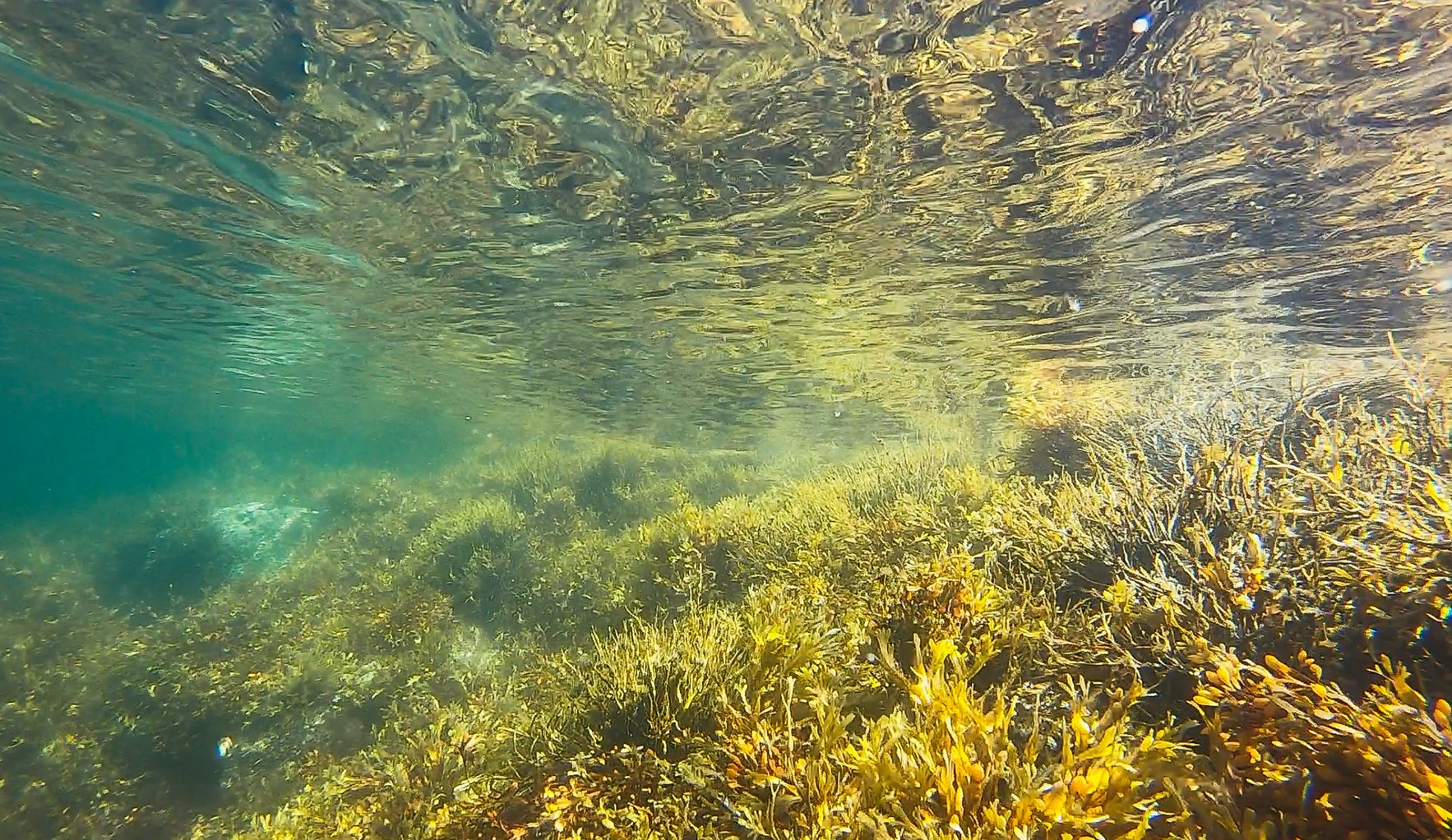
Seaweed and seagrass beds (moba) are shallow coastal areas covered by marine plants, where fish and shellfish spawn and grow. This page lists, from national, prefectural and city documents, the area of seaweed beds in Japan, Saga Prefecture and Karatsu, when and why urchin barrens (isoyake, the loss of seaweed beds) appeared, the money spent on conservation, and blue carbon credits. In the Ministry of the Environment's FY2018–2020 survey, Saga Prefecture had 1,005 ha of seaweed beds and Japan 164,300 ha.
This page is part of the Karatsu Data Bank by Karatsu Farm & Food. It gives no conclusions or evaluations, only the figures and statements found in the documents. Values we calculated are marked "our calculation". Surveys using different methods are not compared as if they were the same. Values read off charts are not used. English renderings of Japanese documents are our translations; the original text takes precedence.
| Scope | 1978 | 1992 | Change | Ratio |
|---|---|---|---|---|
| Japan (total) | 207,615 ha | 201,212 ha | −6,403 ha | 97% |
| Karatsu–Imari sea area | 6,373 ha | 6,366 ha | −7 ha | 100% |
Area of seaweed beds in Japan
Japan's seaweed and seagrass beds fell from 207,615 ha in 1978 to 201,212 ha in 1992, a loss of 6,403 ha (97%). The Karatsu–Imari sea area went from 6,373 ha to 6,366 ha (Ministry of the Environment).
The FY2018–2020 survey mapped seaweed beds from satellite imagery of about 50 cm resolution, checked by field surveys in 59 sea areas. Excluding enclosed seas such as Tokyo Bay, Ise Bay, the Seto Inland Sea and the Ariake Sea, Japan had 164,300 ha (Biodiversity Center of Japan, Ministry of the Environment).
| Survey | Saga | Fukuoka | Nagasaki | Japan |
|---|---|---|---|---|
| 5th survey (1998) | 648 ha | 3,909 ha | 8,394 ha | 145,865 ha |
| Seaweed bed survey (FY2018–2020) | 1,005 ha | 1,971 ha | 19,095 ha | 164,300 ha |
| Category | Survey plots | Area |
|---|---|---|
| Existing beds | 58 | 1,268 ha |
| Lost beds | 1 | 1 ha |
Area of seaweed beds in Saga Prefecture
In the FY2018–2020 survey, Saga Prefecture had 1,005 ha of seaweed beds, excluding its Ariake Sea side. The 5th survey (1998) gave 648 ha, but the source says the two "cannot be simply compared" because the methods differ greatly (Biodiversity Center of Japan). In the 4th survey (1989–1990), existing beds were 1,268 ha in 58 plots and lost beds 1 ha (Biodiversity Center of Japan).
Saga Prefecture's fisheries infrastructure plan for the Genkai area states that the seaweed bed area "has been maintained at about the same level as about 10 years ago", while "localized urchin barrens" have appeared (Saga Prefecture).
| Time / place | What the document says |
|---|---|
| 1990s, Kyushu | Large-scale urchin barrens were reported |
| 2000s, Genkai sea area of Saga | Relatively small-scale urchin barrens began to appear |
| Cause in the Genkai sea area | High densities of Diadema setosum and Heliocidaris crassispina grazing on seaweed |
| East China Sea surface temperature | Up 1.07°C over about 100 years to 2014 |
| From FY2011 | The prefecture's Genkai fisheries center began developing restoration methods |
When and why urchin barrens appeared
In test plots where urchins were removed, large seaweeds tended to increase from about two years after removal. The manual also states that warmer water has increased Diadema setosum and lengthened the season when fish graze on seaweed (Saga Prefecture). Monthly sea temperatures off Genkai are on Genkai Landings and Sea Temperature.
Seaweed and urchin monitoring by the prefecture
The Genkai Fisheries Research and Development Center counts seaweeds and urchins by diving at depths of 0–10 m in three districts (Yakataishi, Hado and Kariya) and publishes the results in its annual reports. The beds are described as mixed beds of Eisenia bicyclis, Ecklonia kurome and perennial Sargassum species (FY2021 report, FY2023 report).
| Program (department) | FY2025 settled amount | Description in the document |
|---|---|---|
| Fishing ground productivity and multifunctional fisheries program (Fisheries) | JPY 7,181,010 | Removal of urchins such as Diadema setosum and of drifting and stranded debris by fishers' groups. City share 15%; national 70% and prefecture 15% paid directly. JPY 8,629,000 carried over to FY2026 |
| Remote island fisheries revitalization grants (Fisheries) | JPY 28,218,000 | Seed release, urchin removal, intermediate rearing of red sea urchins and trial seaweed farming by fishing communities on seven islands |
| Carbon credit creation program (Environment) | JPY 4,598,000 | Plan for credits from marine ecosystems. FY2024: literature review and diving survey; FY2025: draft local action plan |
| Local SDGs creation program (Environment) | JPY 351,940 | Nature positive symposium fee JPY 101,160; blue carbon study trip JPY 250,780 |
Money Karatsu City spends on seaweed beds and fishing grounds
The city's FY2025 grants to 11 conservation groups of fishers totaled JPY 7,181,010, its 15% share; the national government (70%) and Saga Prefecture (15%) paid their shares directly (Karatsu City). If the city's amount is 15% of the total, the combined amount is about JPY 47.87 million (our calculation). Grants to fishing communities on seven islands totaled JPY 28,168,000 (JPY 28,218,000 including office costs).
| Item | Value | Time | Source |
|---|---|---|---|
| Removals by seaweed/seagrass beds and mangroves reported by Japan | about 340,000 t-CO2 | FY2023 | Ministry of the Environment |
| J-Blue Credits certified | 21 projects, 3,733.1 t-CO2 | FY2022 | MLIT |
| of which Kushiura, Chinzei, Karatsu | 41.1 t-CO2 | FY2022 | MLIT |
| Wakame farming education project, Karatsu Bay | 0.4 t-CO2 | certified 10 Jan 2025 | JBE registry |
| Price of the Karatsu Bay wakame credits | JPY 55,000 per 0.1 t-CO2 (tax incl.) | Jan 2025 | Japan Airlines |
Blue carbon and credits
Japan reported removals by seaweed/seagrass beds and mangroves of about 340,000 t-CO2 for FY2023 (Ministry of the Environment). In FY2022, 21 J-Blue Credit projects totaling 3,733.1 t-CO2 were certified, including 41.1 t-CO2 from Kushiura in Chinzei, Karatsu (MLIT). In January 2025 the Karatsu Bay wakame project was certified for 0.4 t-CO2 and offered at JPY 55,000 per 0.1 t-CO2; selling all of it would bring JPY 220,000 (our calculation). Income and costs of nature credits are on Nature Credits in Numbers.
| Campaign | Period | Target | Raised | Donors |
|---|---|---|---|---|
| Turning CO2 uptake of restored beds into credits | 17 Jan – 16 Apr 2025 | JPY 1,000,000 | JPY 202,000 (20.2%) | 15 |
| Urchin removal and mother-seaweed rafts | 9 May – 6 Aug 2025 | JPY 2,000,000 | JPY 550,000 (27.5%) | 23 |
Donations for seaweed bed restoration
The second campaign's JPY 2,000,000 budget was JPY 500,000 for urchin removal and rafts, JPY 700,000 for project management, JPY 500,000 for thank-you gifts and shipping, and JPY 300,000 for the prefecture's fee. It raised JPY 550,000 (Furusato Choice).
FAQ
Q1. What causes urchin barrens off Genkai?
For the Genkai sea area of Saga Prefecture, the prefecture's manual names grazing by high densities of the sea urchins Diadema setosum and Heliocidaris crassispina. It also states that warmer water has increased Diadema setosum and lengthened the season when fish graze on seaweed.
Q2. How large are Japan's seaweed beds?
In the Ministry of the Environment's FY2018–2020 satellite survey, 164,300 ha, excluding enclosed seas such as Tokyo Bay, Ise Bay, the Seto Inland Sea and the Ariake Sea. Between 1978 and 1992 they fell from 207,615 ha to 201,212 ha, a loss of 6,403 ha (4th National Survey).
Q3. How large are Saga Prefecture's seaweed beds?
1,005 ha in the FY2018–2020 satellite survey, excluding the Ariake Sea side. The 5th survey (1998) gave 648 ha, but the source states that the methods differ so much that the two cannot be simply compared.
Q4. How much does Karatsu City spend on seaweed bed conservation?
In FY2025: JPY 7,181,010 in grants to fishers' conservation groups (the city's 15% share), JPY 28,218,000 for fishing communities on seven islands, and JPY 4,598,000 for a plan for marine carbon credits.
Sources
| Document | Publisher | Date | URL | Accessed |
|---|---|---|---|---|
| Decline of tidal flats, seaweed beds and coral (data from the 4th National Survey) | Ministry of the Environment | - | https://www.env.go.jp/nature/koen_umi/umi02_3.pdf | 2026-10-27 |
| 4th National Survey, Marine Biotic Environment, Saga Prefecture | Biodiversity Center of Japan | 1989〜1990年調査 | https://www.biodic.go.jp/reports/4-12/r290.html | 2026-10-27 |
| Seaweed bed area by prefecture (FY2018–2020 survey; 5th survey 1998) | Biodiversity Center of Japan | 2021 | https://www.biodic.go.jp/moba/files/02_11.pdf | 2026-10-27 |
| Results of the seaweed bed survey FY2018–2020 | Ministry of the Environment | 2021-08-31 | https://www.env.go.jp/press/109943.html | 2026-10-27 |
| Seaweed bed restoration manual for the Genkai sea area of Saga Prefecture | Saga Prefectural Genkai Fisheries Research and Development Center | 2015 | https://www.pref.saga.lg.jp/kiji00320179/3_20179_2_mob2015.pdf | 2026-10-27 |
| Comprehensive fisheries infrastructure plan, Genkai area | Saga Prefecture | - | https://www.pref.saga.lg.jp/kiji00380333/3_80333_245881_up_8rwcbmiy.pdf | 2026-10-27 |
| Sea urchin transplantation trials (FY2021 annual report) | Saga Prefectural Genkai Fisheries Research and Development Center | 令和3年度 | https://www.pref.saga.lg.jp/kiji003116451/3_116451_370365_up_03wpwy1v.pdf | 2026-10-27 |
| FY2023 annual report | Saga Prefectural Genkai Fisheries Research and Development Center | 令和5年度 | https://www.pref.saga.lg.jp/kiji00396228/3_96228_370148_up_gbr8wyzc.pdf | 2026-10-27 |
| Report on Results of Major Policies, FY2025 | Karatsu City | 令和7年度 | https://www.city.karatsu.lg.jp/uploaded/attachment/27438.pdf | 2026-10-27 |
| Blue carbon initiatives | Ministry of the Environment | 2026-01 | https://www.env.go.jp/content/000371388.pdf | 2026-10-27 |
| Trends in green infrastructure (Document 3, p.42) | MLIT | 2023-12 | https://www.mlit.go.jp/sogoseisaku/environment/content/001717241.pdf | 2026-10-27 |
| J-Blue Credit registry ver5.0 | Japan Blue Economy Association (JBE) | 2025-12-19 | https://www.blueeconomy.jp/wp-content/uploads/jbc2025/20251219MB-JBC.pdf | 2026-10-27 |
| J-Blue Credit certification for a blue carbon project in Karatsu | Japan Airlines | 2025-01-23 | https://press.jal.co.jp/ja/release/202501/008587.html | 2026-10-27 |
| Hometown tax campaign: blue carbon credits from restored beds | Furusato Choice | 2025 | https://www.furusato-tax.jp/gcf/3806 | 2026-10-27 |
| Hometown tax campaign: seaweed bed restoration | Furusato Choice | 2025 | https://www.furusato-tax.jp/gcf/3983 | 2026-10-27 |
Not covered on this page
Evaluations of individual organizations or projects, values read off charts in presentations, figures we could not confirm in primary sources, and links to offshore development such as offshore wind.
Citing this data, joint research and site visits
If you would like to cite the figures on this page, carry out joint research or visit sites in Karatsu, please get in touch through our contact page or info@karatsu-f-f.com.
About this page
Compiled by Hiroaki Kojima, Vice Director, Karatsu Farm & Food / Contact: info@karatsu-f-f.com / Published: 27 October 2026 / Markdown: seaweed-beds-data.mdThis page was made with AI. See How we use AI.
Related
▶ Karatsu Data Bank
▶ Genkai Landings and Sea Temperature
▶ Nature Credits in Numbers
▶ 藻場と磯焼けの統計(日本語)