
Training and volunteering in numbers
In Saga Prefecture, 175,000 people aged 10 and over volunteered in the year from October 2020 to October 2021, a rate of 24.8%. That is 7.0 points above the national rate (17.8%) and the second highest of Japan's 47 prefectures (Saga Prefecture, summary of the 2021 Survey on Time Use and Leisure Activities). On the employer side, 7.3% of firms had a volunteer leave scheme on 1 January 2025 (MHLW, General Survey on Working Conditions 2025), and firms that paid for off-the-job training (OFF-JT) spent an average of ¥20,000 per worker in FY2024 (MHLW, Basic Survey of Human Resources Development FY2025).
This page is part of the Karatsu Data Bank, compiled by Karatsu Farm & Food, a non-profit in Karatsu, Saga. It lists figures on workplace training and local volunteering exactly as published by the national government and Saga Prefecture, without conclusions or ratings. Where we have ranked or reordered figures ourselves, we say so.
"Volunteering" here follows the definition in the Survey on Time Use and Leisure Activities: activities done without aiming for pay, giving one's own labour, skills or time to promote the welfare of the community, individuals or groups. The survey divides them into 11 types: "community development" includes cleaning roads and parks, and "protecting nature and the environment" includes protecting forests and greenery, recycling drives and waste reduction. "OFF-JT" is the MHLW term for education and training that employees take on their employer's instruction while temporarily away from their normal work.
Volunteering in Saga Prefecture (2021)
The Survey on Time Use and Leisure Activities is held every five years; the latest results are from the survey of 20 October 2021. Saga's volunteering rate was 24.8% (men 27.9%, women 22.0%), down 7.8 points from 32.6% in 2016. Nationally the rate fell from 26.0% in 2016 to 17.8% in 2021 (Saga Prefecture summary (PDF, Japanese), Statistics Bureau of Japan, summary of results (PDF, Japanese)). The Saga summary notes that the survey period included two COVID-19 states of emergency.
By type of activity, "community development" was the most common in Saga at 14.0%, about twice the national rate (7.4%). "Protecting nature and the environment" was 4.9% (Japan 3.0%). When we sort the prefectural table (e-Stat Table 102-2), Saga has the highest rate of the 47 prefectures for both of these types.
| Prefecture | Volunteering (total) | Community development | Nature and environment |
|---|---|---|---|
| Fukuoka | 19.1% | 9.0% | 3.8% |
| Saga | 24.8% | 14.0% | 4.9% |
| Nagasaki | 21.0% | 11.0% | 3.9% |
| Kumamoto | 22.1% | 11.3% | 4.3% |
| Oita | 20.3% | 9.1% | 3.1% |
| Miyazaki | 20.1% | 8.5% | 3.6% |
| Kagoshima | 22.3% | 11.2% | 4.3% |
| Okinawa | 17.4% | 7.1% | 3.0% |
| Japan | 17.8% | 7.4% | 3.0% |
The table below shows rates by type of activity for Saga and Japan. One person may do several types, so the types do not add up to the total.
| Type of volunteering | Saga | Japan |
|---|---|---|
| Community development | 14.0% | 7.4% |
| Activities for children | 5.5% | 4.6% |
| Protecting nature and the environment | 4.9% | 3.0% |
| Safety in daily life | 4.5% | 3.1% |
| Activities for older people | 3.6% | 2.4% |
| Sports, culture, arts and learning | 3.2% | 2.8% |
| Health and medical services | 2.3% | 2.1% |
| Disaster-related activities | 1.8% | 0.8% |
| Activities for people with disabilities | 1.1% | 0.9% |
| International cooperation | 0.7% | 0.8% |
| Other | 1.6% | 2.0% |
By form of activity, 18.1% of people in Saga volunteered through a group or organisation (Japan 12.1%), including 12.9% through neighbourhood associations and similar local bodies (Japan 7.5%). 7.4% volunteered without joining a group (Japan 5.9%).
| Form of volunteering | Saga | Japan |
|---|---|---|
| Through a group or organisation | 18.1% | 12.1% |
| of which: neighbourhood associations and similar local bodies | 12.9% | 7.5% |
| of which: volunteer clubs, circles and civic groups | 3.1% | 2.5% |
| of which: NPOs (specified non-profit corporations) | 0.7% | 0.7% |
| of which: other groups | 4.1% | 3.4% |
| Without joining a group | 7.4% | 5.9% |
Source: Statistics Bureau of Japan, 2021 Survey on Time Use and Leisure Activities, Questionnaire A, Table 102-2 (published 31 August 2022).
How many firms offer volunteer leave?
The MHLW General Survey on Working Conditions covers private firms with 30 or more regular employees. On 1 January 2025, 60.3% of firms had some form of special leave, and 7.3% of all firms had volunteer leave. The rate was 6.5% in the previous year's survey and 4.6% in the 2020 survey (2025 survey summary (PDF, Japanese), 2020 survey summary (PDF, Japanese)). By firm size, the rate was 26.5% for firms with 1,000 or more employees and 5.3% for firms with 30 to 99.
| Firm size (employees) | Volunteer leave | Education and training leave | Refresh leave |
|---|---|---|---|
| 1,000 or more | 26.5% | 6.9% | 44.4% |
| 300 to 999 | 14.4% | 6.2% | 29.6% |
| 100 to 299 | 9.4% | 4.1% | 23.5% |
| 30 to 99 | 5.3% | 5.6% | 10.4% |
| All firms | 7.3% | 5.4% | 15.4% |
"Special leave" means leave other than statutory leave (such as annual paid leave or childcare leave) that is recognised as a scheme, including established practice, in work rules (note to the survey table).
How much do firms spend on training?
In the MHLW Basic Survey of Human Resources Development (firms and establishments with 30 or more regular employees, published 31 July 2026), 54.4% of firms spent money on education and training (OFF-JT or support for self-development) in FY2024. Spending on OFF-JT averaged ¥20,000 per worker (¥15,000 in the previous survey), and spending on self-development support averaged ¥4,000 per worker (unchanged). Both are averages among firms that spent money (MHLW press release, Japanese).
| Item | Value | Period |
|---|---|---|
| Firms spending on education and training | 54.4% | FY2024 |
| OFF-JT spend per worker (average of firms that spent) | ¥20,000 | FY2024 |
| Self-development support per worker (average of firms that spent) | ¥4,000 | FY2024 |
| Firms with an education and training leave scheme | 5.7% | FY2025 survey |
| Workers who took OFF-JT (regular / non-regular) | 37.3% (44.5% / 19.4%) | FY2025 survey |
| Workers who did self-development | 35.5% | FY2025 survey |
The share of firms with education and training leave is 5.7% in the Basic Survey of Human Resources Development and 5.4% in the General Survey on Working Conditions. The two surveys differ in scope, timing and wording, so the figures do not match.
Corporate training in Karatsu (our own work)
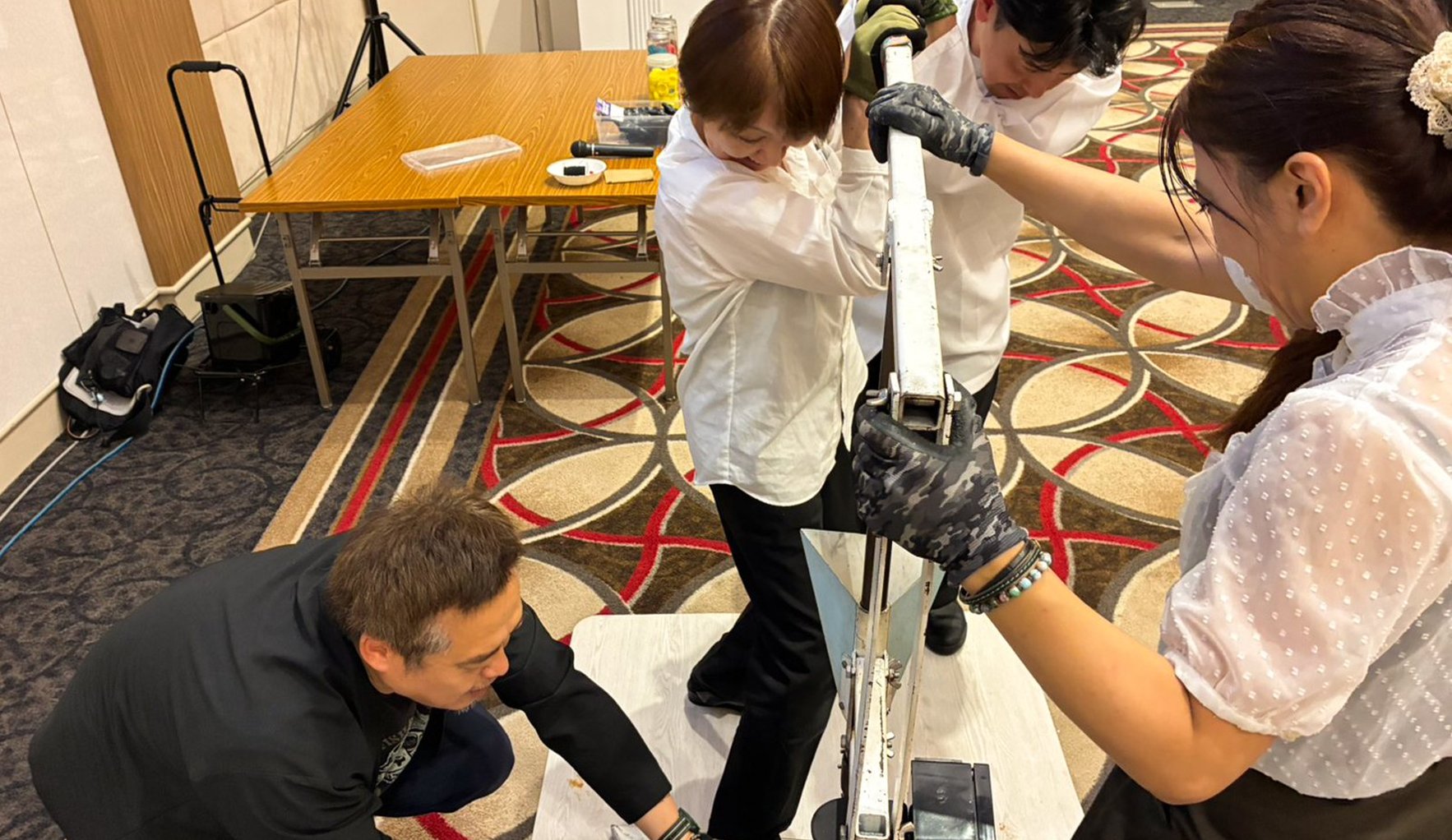
Our Precious Plastic Karatsu programme hosts corporate training sessions in which participants mould plastic bottle caps on hand-operated machines. Staff of Hitachi Academy Co., Ltd. visited Karatsu for a site visit and moulding session in July 2025, and on 7 January 2026 made 60 penguin keyrings in Karatsu. At Mercure Saga Karatsu Resort, 14 staff took part in a coaster-making session using bottle caps on 1 July 2026 as part of the hotel's company-wide training (case study, Japanese, Mercure Saga Karatsu Resort, Japanese).
FAQ
Q1. How much do Japanese companies spend on employee training?
In FY2024, firms that paid for off-the-job training (OFF-JT) spent an average of ¥20,000 per worker, and ¥4,000 per worker on self-development support (MHLW, Basic Survey of Human Resources Development FY2025). We have not found a public statistic on the typical price of a single training session.
Q2. What share of Japanese companies offer volunteer leave?
7.3% of private firms with 30 or more regular employees, as of 1 January 2025 (MHLW, General Survey on Working Conditions 2025). The rate was 26.5% for firms with 1,000 or more employees and 5.3% for firms with 30 to 99.
Q3. Do many people volunteer in Saga Prefecture?
In the 2021 Survey on Time Use and Leisure Activities, Saga's volunteering rate was 24.8%, 7.0 points above the national rate (17.8%) and second among the 47 prefectures. When we sort the prefectural table, Saga has the highest rates for community development (14.0%) and protecting nature and the environment (4.9%).
Q4. Is volunteering increasing?
The national rate fell from 26.0% in 2016 to 17.8% in 2021, and Saga's from 32.6% to 24.8%. The 2021 survey period (October 2020 to October 2021) included two COVID-19 states of emergency.
Q5. Can companies do training or volunteering in Karatsu?
Our Precious Plastic Karatsu programme hosts corporate sessions in which participants mould plastic bottle caps. Hitachi Academy staff made 60 penguin keyrings on 7 January 2026, and 14 staff of Mercure Saga Karatsu Resort made coasters on 1 July 2026.
Source register
| Source | Publisher | Date | URL | Accessed |
|---|---|---|---|---|
| 2021 Survey on Time Use and Leisure Activities, results on activities (summary, Table 102-2) | Statistics Bureau of Japan (MIC) | Published 2022-08-31 | https://www.stat.go.jp/data/shakai/2021/kekka.html | 2026-11-15 |
| 2021 Survey on Time Use and Leisure Activities, Saga Prefecture summary | Saga Prefecture, Statistics and Analysis Division | Updated 2023-04-28 | https://www.pref.saga.lg.jp/toukei/kiji00395967/index.html | 2026-11-15 |
| Basic Survey of Human Resources Development FY2025 (press release and summary) | MHLW | Published 2026-07-31 | https://www.mhlw.go.jp/stf/houdou/newpage_00233.html | 2026-11-15 |
| General Survey on Working Conditions 2025, summary (Table 7) | MHLW | 2025 | https://www.mhlw.go.jp/toukei/itiran/roudou/jikan/syurou/25/index.html | 2026-11-15 |
| General Survey on Working Conditions 2020, summary (Table 7) | MHLW | 2020 | https://www.mhlw.go.jp/toukei/itiran/roudou/jikan/syurou/20/dl/gaikyou.pdf | 2026-11-15 |
| Case studies: Hitachi Academy / Mercure Saga Karatsu Resort | Karatsu Farm & Food | As stated on each page | https://karatsu-f-f.com/hitachi.html / https://karatsu-f-f.com/mercure.html | 2026-11-15 |
Notes on reading the figures
Rates in the Survey on Time Use and Leisure Activities are the share of people aged 10 and over who did the activity in the past year, estimated from a sample. In Table 102-2 the sample size is 171,360 people for Japan and 3,427 for Saga. Prefectural rankings are our own ordering of the published one-decimal figures; prefectures with the same value share a rank. Saga's second place for the total is the rank stated by Saga Prefecture.
The two MHLW surveys cover firms with 30 or more regular employees and exclude smaller firms and sole proprietors. OFF-JT spending is the average among firms that spent money, not across all firms. MHLW has corrected figures in the FY2018 to FY2024 editions of the Basic Survey of Human Resources Development, so this page uses only values stated in the FY2025 release.
What this page does not cover
We do not cover the prices charged by individual training providers, comparisons of individual companies' volunteering, analysis of why people volunteer, or volunteering rates for municipalities within Saga (the survey does not publish them). Corporate social contribution budgets are in ESG, CSR and CSV Data, and hotel groups' staff volunteering hours are in Hotel Sustainability Data.
Citing this page and enquiries
To cite figures from this page or to ask about hosting corporate training or staff volunteering, please use our contact page or write to info@karatsu-f-f.com.
About this page
By Hiroaki Kojima (Vice Director, Karatsu Farm & Food) / Contact: info@karatsu-f-f.com (contact page) / Published: 15 November 2026 / Markdown: training-volunteer-data.mdThis page is made together with AI. See this data bank and AI for how.
Related links
▶ Karatsu Data Bank
▶ ESG, CSR and CSV Data
▶ Hotel Sustainability Data
▶ Precious Plastic Karatsu
▶ 社員研修とボランティアのデータ(日本語)