
🌐 日本語版はこちら / Read this page in Japanese
The island where the ocean's plastic comes ashore
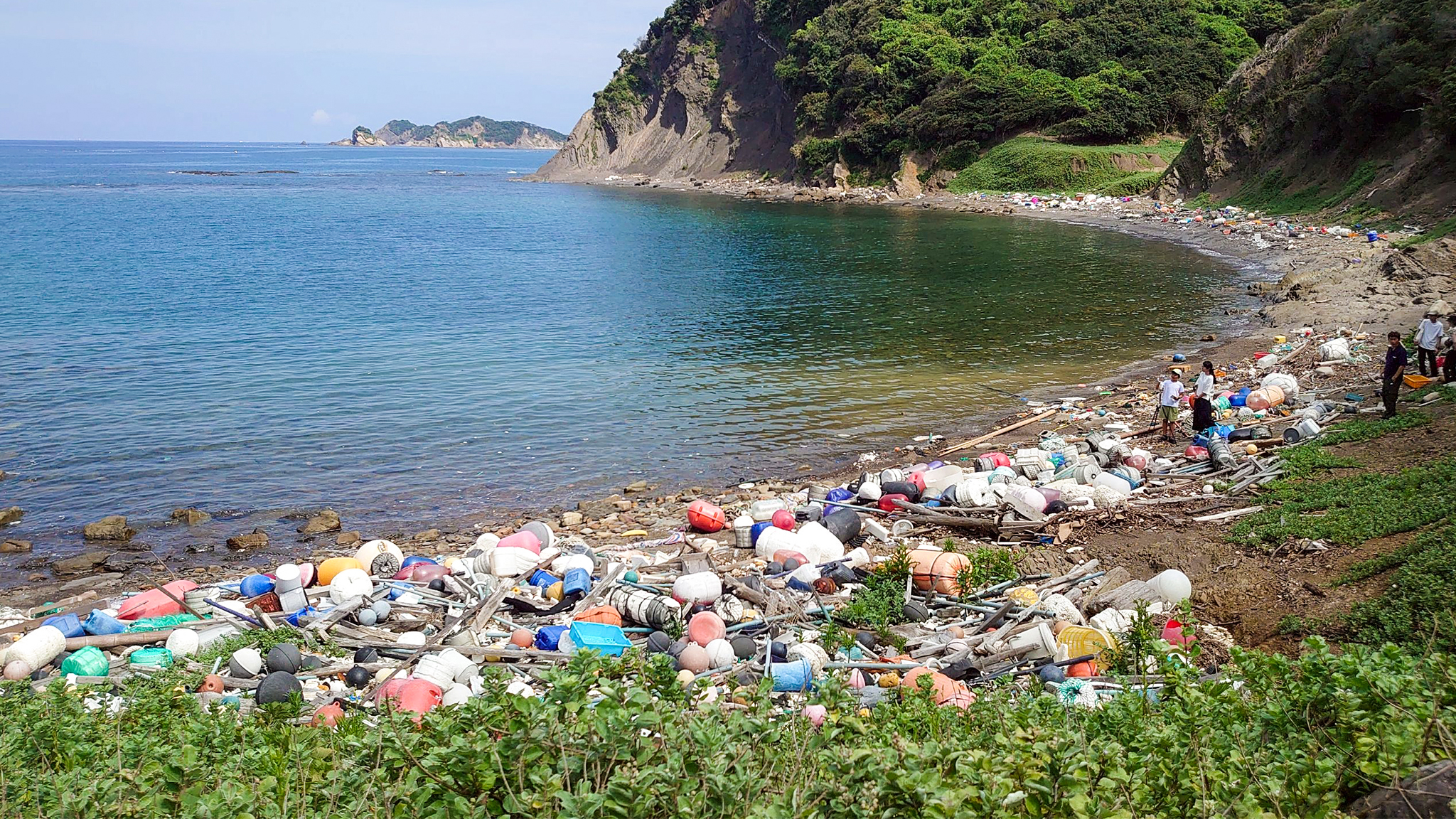
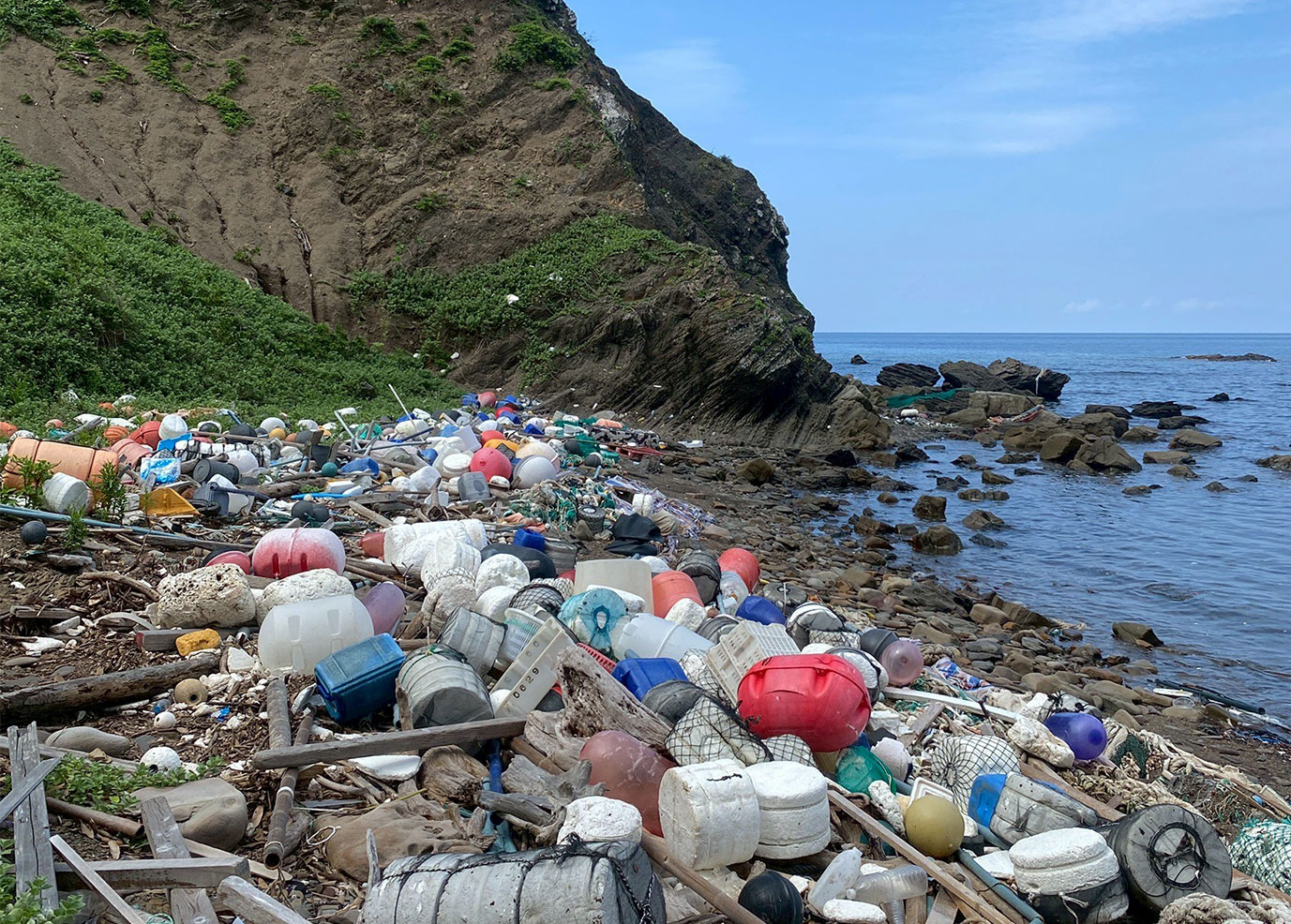
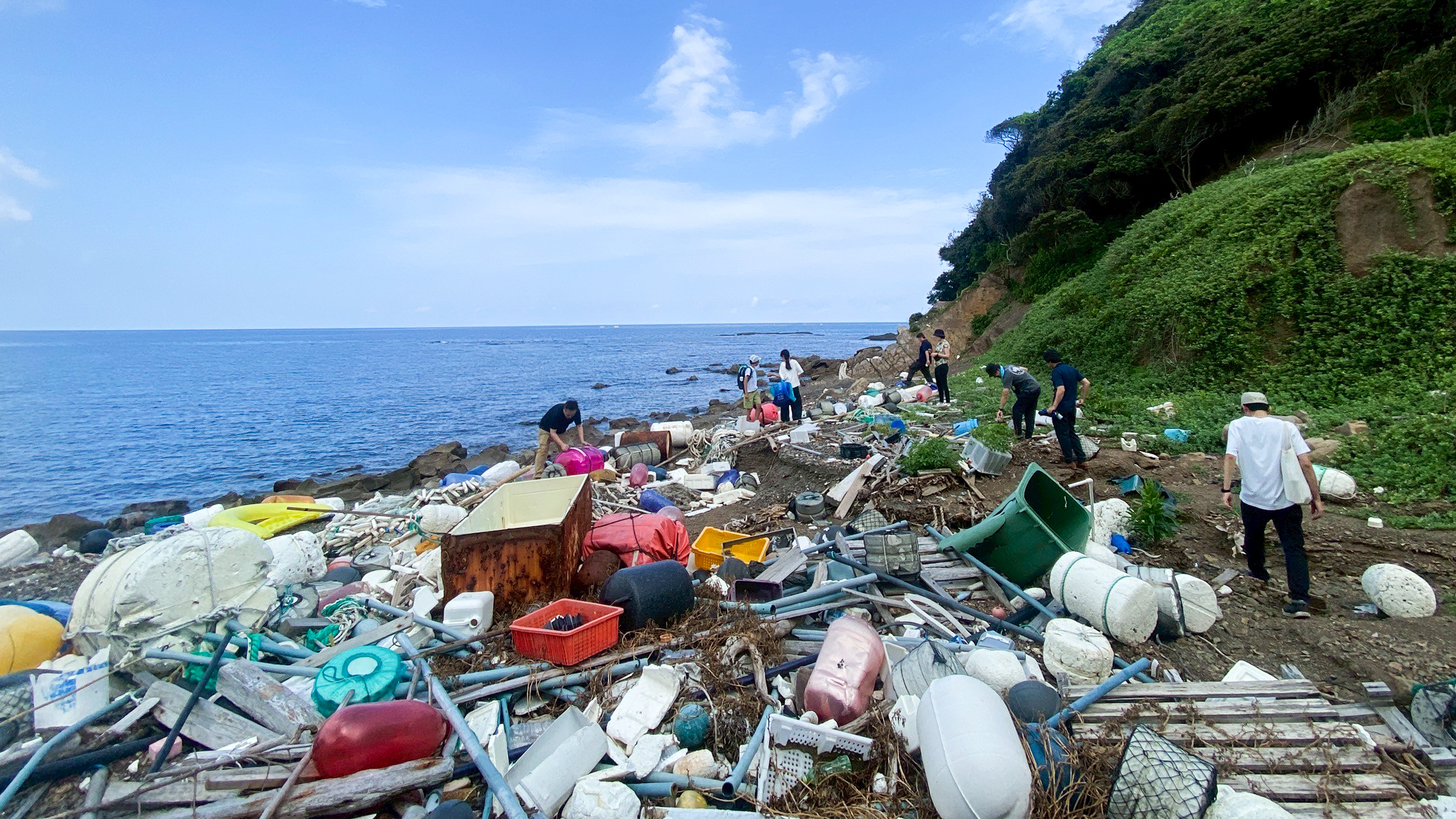
This is not a landfill. It is a beach on Tsushima, a Japanese island in the strait between Kyushu and the Korean Peninsula. According to Tsushima City, about 40,000 cubic meters of marine debris — roughly a hundred 25-meter swimming pools — wash up on its shores every year, more than anywhere else in Japan. Around 70% of it drifts in from overseas. Even with about ¥280 million a year in municipal and national funds, only about 30% can be collected and processed. On some beaches the broken plastic lies so deep that the ground sinks softly underfoot.
The Tsushima WAVE Project exists to change what happens next. Instead of ending at collection and disposal, the plastic that the sea could not hold becomes material — and then art. On Marine Day, July 20, 2026, the project officially launched under the Tsushima WAVE Project Executive Committee, in cooperation with Tsushima City and Hakata Daimaru Co., Ltd. (official announcement, in Japanese).
Our position: the best ocean plastic is none at all
We look forward to the day when this material can no longer be found. WAVE's artworks are born from what the sea could not hold — so we sincerely hope our own supply runs out. Upcycling is a bridge to that day, not a destination. The goal is not a society that keeps circulating waste more cleverly, but one where plastic stops reaching the sea at all. This conviction comes directly from our years running Precious Plastic Karatsu, part of the global open-source Precious Plastic movement — and it is the standard we hold this project to.
Public art, made by the sea's own debris
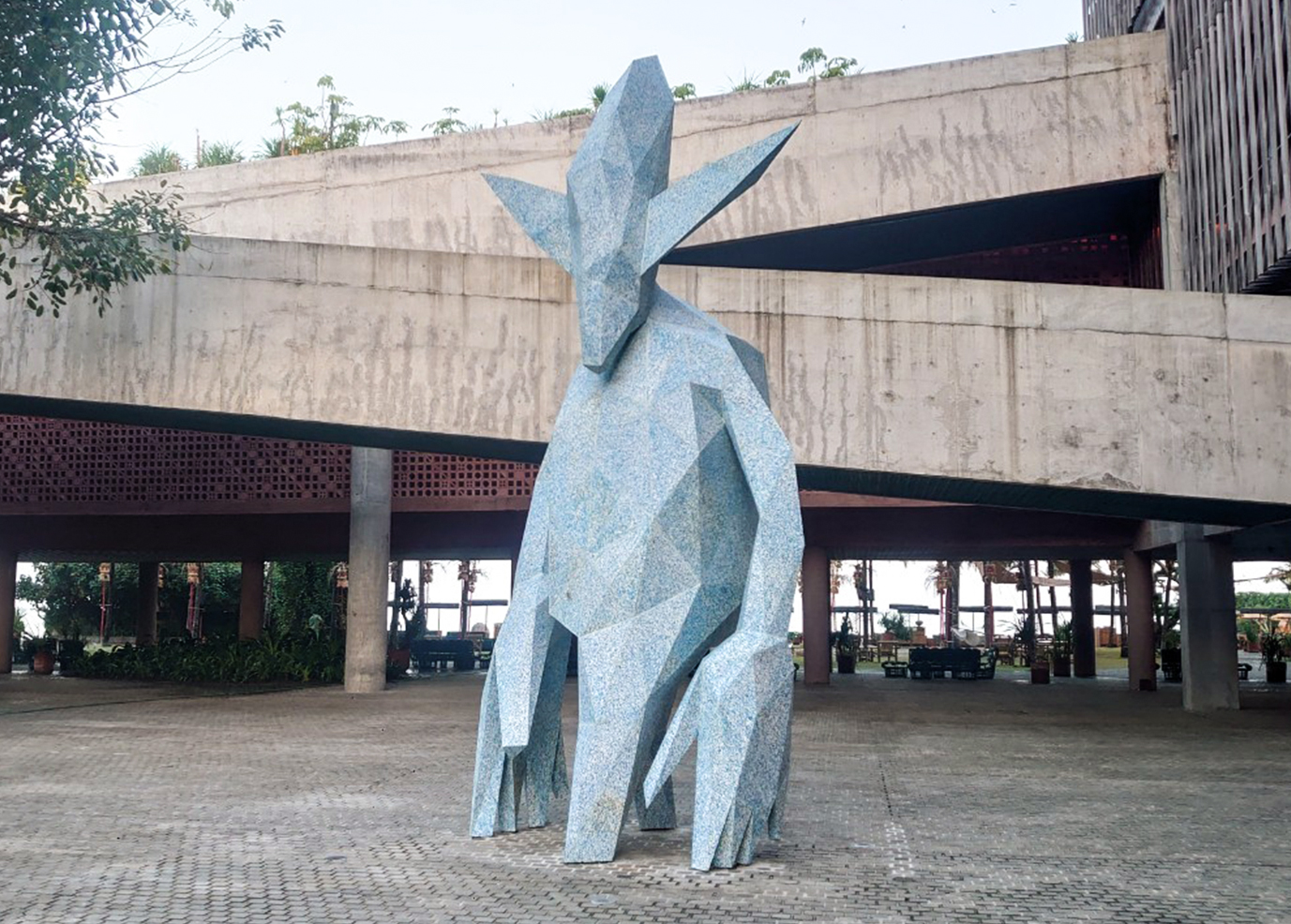
The project's symbol will be a work of public art standing at a port on Tsushima — made from 100% Tsushima ocean plastic — greeting every traveler who crosses the sea to the island. Around the world, ocean-plastic public art has become a shared language: at Desa Potato Head in Bali, which we visited, FUTURA2000's monumental figure made of plastic collected from the island's waterways draws global attention. WAVE is Japan's answer to that movement — with a voice no one else has.
The artist: Hiromine Nakamura, fourth-generation Hakata doll master
The art is led by Hiromine Nakamura, fourth-generation master of Nakamura Ningyo, a Hakata doll workshop founded in 1917 in Fukuoka. Born in 1986, he trained in sculpture at the graduate school of Tokyo University of the Arts before inheriting the family workshop. A full member of the Japan Kōgei Association, his honors include the Asahi Shimbun Prize at the Japan Traditional Kōgei Exhibition (2023) and the Fukuoka City Culture Prize (2025). His work asks: "If a master doll maker of the Edo period time-slipped into the present, what would he make?" — and answers with pieces for the people of now.
In Japan, a doll is a prayer given form. An artwork born from that tradition — shaped out of the sea's own debris — will be something that exists nowhere else in the world.
And Nakamura has a personal reason: his great-grandmother was from Tsushima. In February 2026 he stood on the island's buried beaches, beginning the work where the material begins.
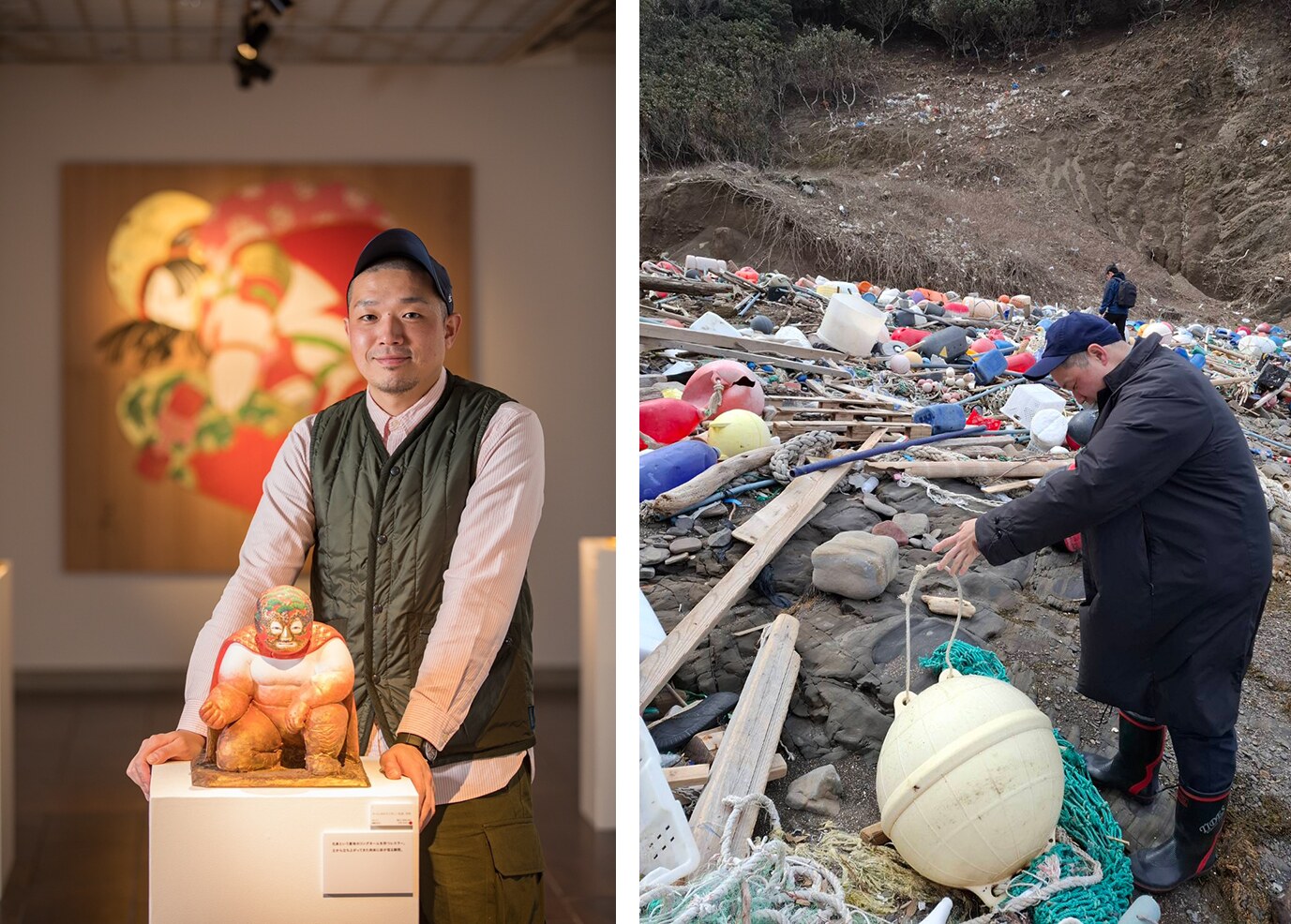
"Tsushima's ocean plastic is a deeply serious problem in itself — and at the same time, the tip of the iceberg of the pollution facing every ocean on Earth. If the environment keeps degrading, one day it will become impossible to carry the traditional craft I inherited into the future. This is not someone else's problem. And my great-grandmother was from Tsushima. If I can give even a small shape to what I can do for this island — that is why I joined this project."
Hiromine Nakamura, Nakamura Ningyo, 4th generation(translated from the official announcement)The material: 100% ocean plastic, industrial grade
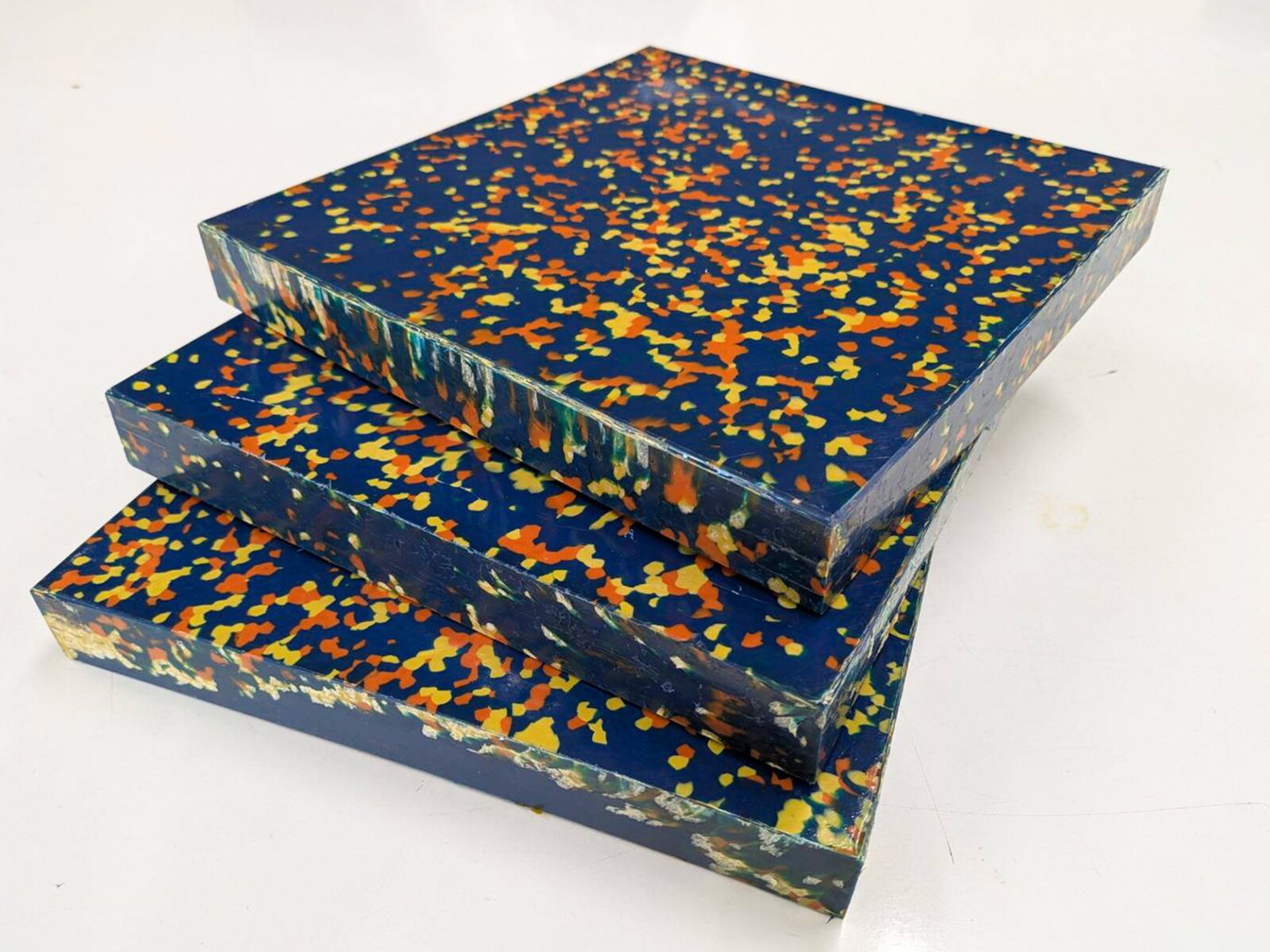
Most "ocean plastic" products quietly blend in virgin resin. WAVE's sheet material does not. Mutsumi Industry Co., Ltd. — an industrial press manufacturer in Nagoya founded in 1949, ISO 9001 and ISO 14001 certified — presses sheets from 100% ocean-recovered plastic collected on Tsushima's beaches, with no virgin material added. The colors of the drifted debris surface as a pattern that runs through the full cross-section, different in every sheet: material strong enough for architecture, furniture and public art. This is community recovery meeting serious Japanese manufacturing.
Keeping the value on the island
Today, most plastic recovered on Tsushima leaves the island to be processed — so the transport costs stay, and the value leaves. WAVE is building a complete loop on Tsushima itself: collection, washing, shredding and sheet-pressing all happening on the island, so that the value, the jobs and the story stay where the plastic lands. It starts with machines and hands-on training from Precious Plastic Karatsu. And a loop that works on Japan's most debris-burdened island is a model that can travel — to other islands, and to coasts across Asia facing the same tide.
An ocean without borders
Tsushima sits about 50 km from Busan, South Korea — closer to Korea than to mainland Japan. The debris on its beaches comes from across East Asia and beyond; the currents that bring it also connect Tsushima to Karatsu, to the Korean coast, to Taiwan and Southeast Asia. Visitors from abroad who stand on these beaches meet an uncomfortable, powerful fact: this is their ocean too. WAVE treats that not as an accusation but as an invitation — the problem crosses borders, so the response should as well.
A story that has been building for years
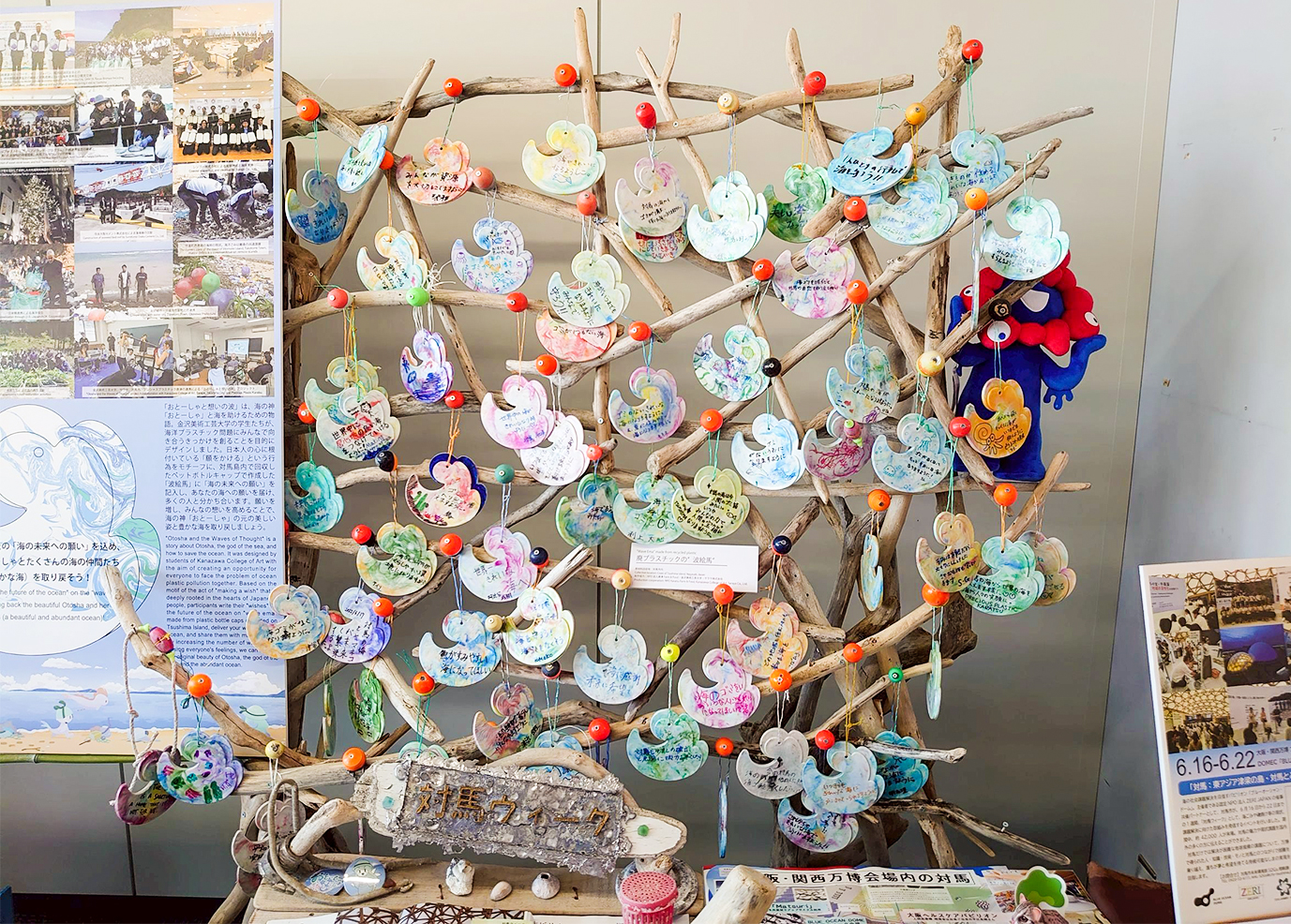
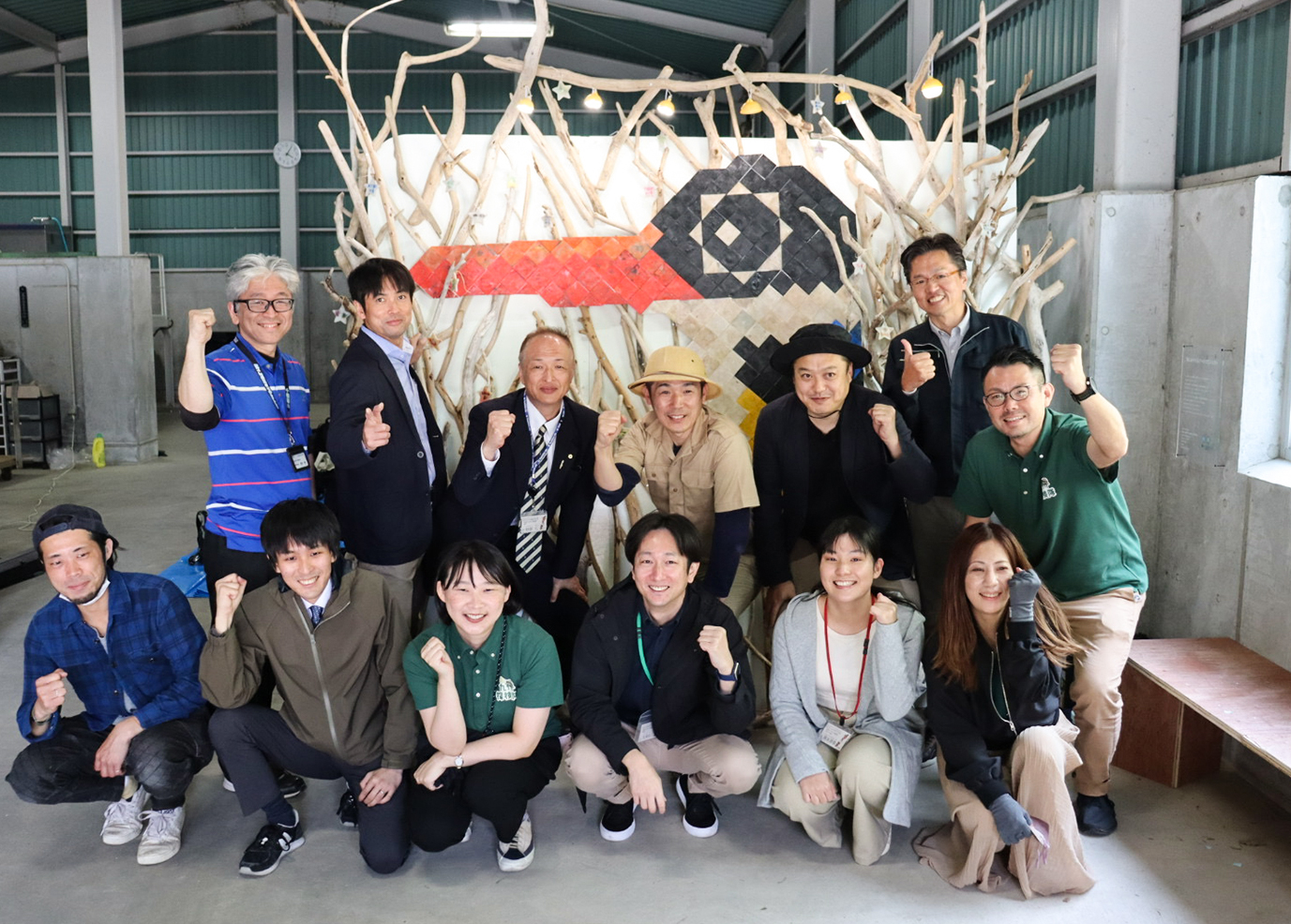
WAVE did not appear from nowhere. In 2022, Tsushima City and Hakata Daimaru signed an SDGs partnership agreement; together with the department store's Kyushu Tankentai team we created tile art of the yamashōbin — Tsushima's emblematic migratory kingfisher — from ocean plastic, hand-made with local junior-high and high-school students. At EXPO 2025 Osaka's Blue Ocean Dome, visitors wrote wishes for the ocean's future on wave-ema votive tablets made from bottle caps recovered on Tsushima. In 2026 the 100%-ocean-plastic sheet was prototyped, and on Marine Day the executive committee officially launched. Tiles, then ema, then a figure standing at the port: the story keeps growing.
Who is behind WAVE
The project runs as an executive committee where every member brings their own strength: Tsushima City; the Hakata Daimaru department store (Daimaru Fukuoka Tenjin), which chairs the executive committee; Tsushima CAPPA, which has led beach recovery on the island for years; Mutsumi Industry for sheet manufacturing; and artist Hiromine Nakamura. Karatsu Farm & Food directs the project overall and provides recycling expertise and field coordination through Precious Plastic Karatsu — building on 25,971 workshop participants and 3,026 kg of plastic recovered since 2020.
Collaborate with us
We are looking for partners across Asia and beyond — and we mean working partners, not logos. If you are a Precious Plastic workspace or community recycler, we would love to exchange materials, techniques and stories, and welcome you to Karatsu and Tsushima. If you are an artist working with marine debris, anywhere the same tide reaches — let's talk about what our islands can make together. If you are a museum, festival or symposium, the WAVE story — and the material itself — travels well. And if you are a company or foundation, there are concrete ways to take part, from beach recovery to materials, venues and funding.
The same currents that carry debris to Tsushima flow past the coasts of Korea and China — which is exactly why partners there matter most to us. We are just as keen to work with friends in Taiwan, Singapore and Thailand, and in Europe, where ties like Precious Plastic France already point the way — Italy, we would love to hear from you too.
Precious Plastic Karatsu, run by Karatsu Farm & Food, is the international contact point for the WAVE project. We read and write English well; for calls, an interpreter helps, so tell us your preferred language.
Related
▶ Precious Plastic Karatsu — Japan's hub for community plastic upcycling
▶ Precious Plastic (global open-source project)
▶ Regenerative tourism & corporate study visits
▶ 日本語版:対馬WAVEプロジェクト
About the organization
Karatsu Farm & Food
A non-profit based in Karatsu City, Saga Prefecture, Japan, working on ocean-plastic solutions, the circular economy, environmental education (ESD) and the management of Saga's first OECM site. As Japan's hub for community-based plastic upcycling and Japan's first Ecosystem Restoration Communities site, we recover plastic, remake it into things people want to keep, and help new groups start their own. Think Locally, Act Globally.