
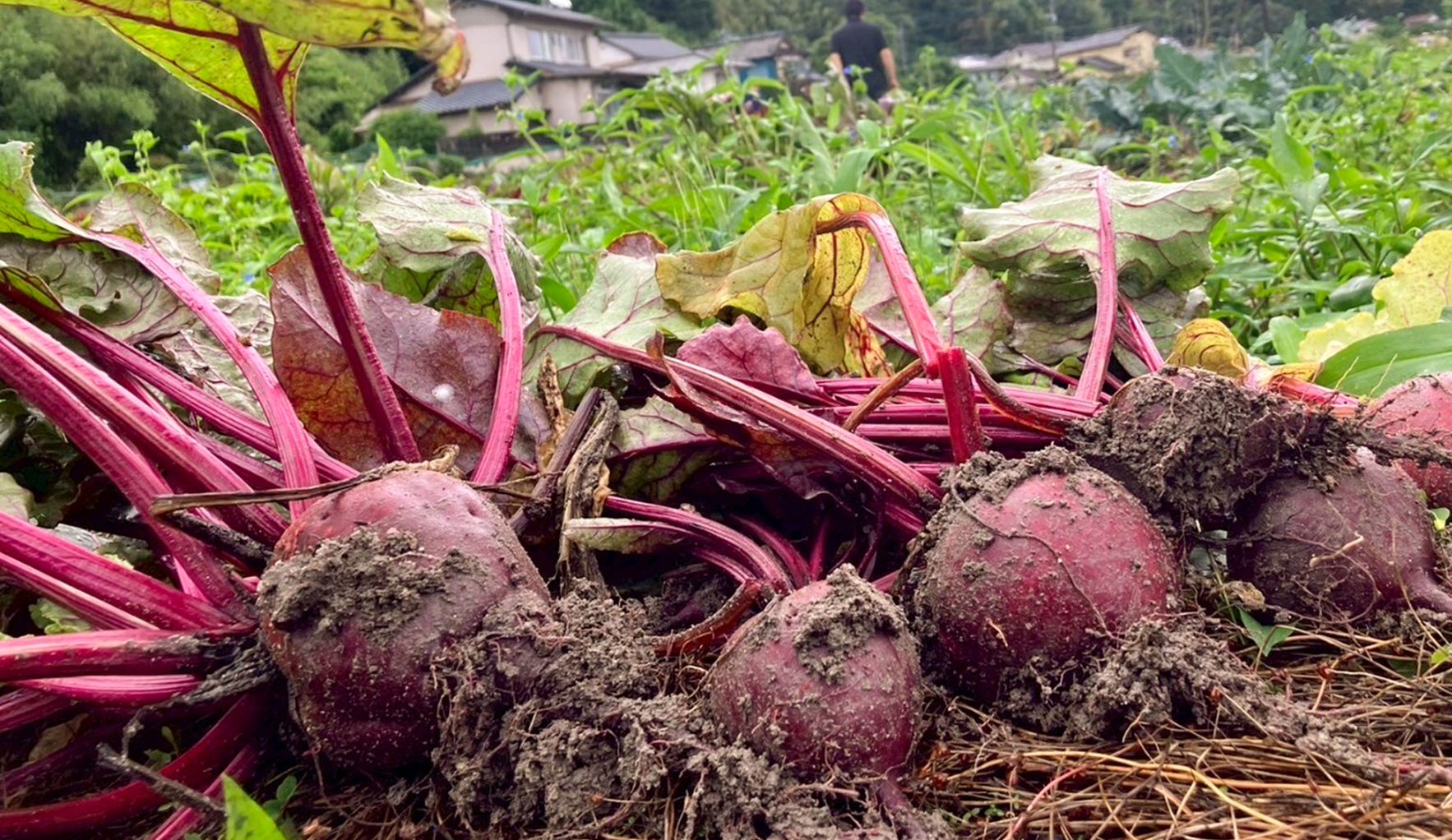
How nutritious are beets? (Food Composition Tables, 2023 supplement)
Per 100 g edible portion, raw beetroot has 38 kcal, 460 mg of potassium, 110 µg of folate and 2.7 g of total dietary fibre, and the remarks column gives 0.3 g of nitrate ion (MEXT, Standard Tables of Food Composition in Japan 2020 (Eighth Revised Edition), Supplement 2023, data updated 27 March 2026). Japan's national statistics have no beet production by prefecture, because the latest (2024 crop) survey of regional specialty vegetables by MAFF has no beet item. For sugar beet, the same species grown for sugar, Russia was the largest producer in 2024 with 46.7 million t, and Japan ranked 17th with 3,485,000 t (FAO, FAOSTAT, sorted by us).
This page was made by Karatsu Farm & Food as part of the Karatsu Data Bank. It looks at beets (table beet) in the world (sugar beet production by country), Japan (nutrients compared, what public bodies say about nitrate, national statistics, sugar beet in Hokkaido), Saga and Karatsu. Yokomakura Farm's beets in Karatsu are described on Yokomakura Farm beets (Japanese), and a recipe is on borscht recipe (Japanese).
| Question | Figure | Period | Source |
|---|---|---|---|
| Potassium in beets (root, raw) | 460 mg | per 100 g edible portion | MEXT |
| Folate in beets (root, raw) | 110 µg | per 100 g edible portion | MEXT |
| Nitrate ion in beets (root, raw) | 0.3 g | per 100 g (remarks column) | MEXT |
| Acceptable daily intake (ADI) for nitrate | 3.7 mg per kg body weight per day (as nitrate ion) | confirmed 2017 | EFSA, Food Safety Commission |
| Beet production by prefecture | not in national statistics | surveys up to 2024 crop | MAFF |
| Top sugar beet producer | Russia 46,680,177 t | 2024 | FAO (sorted by us) |
| Sugar beet harvest in Japan (Hokkaido) | 3,195,000 t | 2025 crop | MAFF |
Sugar beet production by country (2024)
There are no world statistics for table beet alone. In FAOSTAT the only items containing "beet" are sugar beet and raw cane or beet sugar; table beet is not a separate item (FAO, FAOSTAT). We therefore list sugar beet, the same species, by country. World production in 2024 was 293,624,598 t (about 294 million t). Of the 62 countries reporting a 2024 value, 57 produced sugar beet (the other five reported zero; our count).
| Rank | Country | Sugar beet production (t) | Share of world | Flag |
|---|---|---|---|---|
| 1 | Russia | 46,680,177 | 15.9% | I |
| 2 | Germany | 36,682,200 | 12.5% | A |
| 3 | France | 32,594,090 | 11.1% | A |
| 4 | United States | 32,003,660 | 10.9% | A |
| 5 | Türkiye | 23,000,000 | 7.8% | A |
| 6 | Poland | 18,430,330 | 6.3% | A |
| 7 | Egypt | 13,880,842 | 4.7% | I |
| 8 | Ukraine | 12,798,210 | 4.4% | A |
| 9 | China, mainland | 12,411,200 | 4.2% | A |
| 10 | United Kingdom | 7,816,758 | 2.7% | A |
| 17 | Japan | 3,485,000 | 1.2% | A |
| World | 293,624,598 | 100.0% | A |
Beets and sugar beet: the difference
The composition tables explain that "beets" include cultivars for vegetables (table beet), for sugar (sugar beet) and for fodder, and that table beet was used as the sample. Table beet, also called kaensai, is red and round like a radish or red turnip, and shows concentric red rings when sliced (MEXT, Food Composition Tables 2023 supplement, e-book, PDF page 161). Other names listed are beet, beetroot, red beet, table beet and kaensai. Nutrient figures on this page are for table beet; production figures are for sugar beet.
Beet nutrients compared with other vegetables (2023 supplement)
We compared raw beetroot with carrot, daikon radish and turnip (root, peeled, raw), spinach (leaves, annual average, raw) and red tomato (fruit, raw) for potassium, folate, total dietary fibre and nitrate ion. Beets rank second after spinach for potassium and folate, and have the highest nitrate ion of the six at 0.3 g (MEXT, composition data, chapter 2, sorted by us).
| Food | Food No. | Potassium (mg) | Folate (µg) | Total dietary fibre (g) | Nitrate ion (g) |
|---|---|---|---|---|---|
| Spinach, leaves, annual average, raw | 06267 | 690 (1st) | 210 (1st) | 2.8 (1st) | 0.2 (2nd) |
| Beets, root, raw | 06243 | 460 (2nd) | 110 (2nd) | 2.7 (3rd) | 0.3 (1st) |
| Carrot, root, peeled, raw | 06214 | 300 (3rd) | 23 (5th) | 2.8 (1st) | 0 (5th) |
| Turnip, root, peeled, raw | 06038 | 250 (4th) | 49 (3rd) | 1.4 (4th) | 0.1 (4th) |
| Daikon radish, root, peeled, raw | 06134 | 230 (5th) | 33 (4th) | 1.3 (5th) | 0.2 (2nd) |
| Red tomato, fruit, raw | 06182 | 210 (6th) | 22 (6th) | 1.0 (6th) | 0 (5th) |
| Component | Unit | Beets, root, raw (06243) | Beets, root, boiled (06244) |
|---|---|---|---|
| Energy | kcal | 38 | 42 |
| Water | g | 87.6 | 86.9 |
| Protein | g | 1.6 | 1.5 |
| Carbohydrate | g | 9.3 | 10.2 |
| Total dietary fibre | g | 2.7 | 2.9 |
| Potassium | mg | 460 | 420 |
| Magnesium | mg | 18 | 22 |
| Iron | mg | 0.4 | 0.4 |
| Folate | µg | 110 | 110 |
| Vitamin C | mg | 5 | 3 |
| β-carotene equivalents | µg | (0) | (0) |
| Nitrate ion (remarks column) | g | 0.3 | 0.3 |
Benefits of beets and beet powder? What public bodies say about nitrate
We do not judge the health effects of beets. Here we list only the composition figures and what public bodies say about nitrate. Raw beetroot contains 0.3 g of nitrate ion per 100 g in the composition tables (table above). The values on this page are for raw and boiled root, not for powder.
In 2017 the European Food Safety Authority (EFSA) confirmed the current acceptable daily intake (ADI) for nitrates of 3.7 mg per kg body weight per day. It found nitrate from food additives to be less than 5% of total dietary exposure and within safe levels, but said that if all sources of dietary nitrate are considered (food additives, natural presence in foods and environmental contaminants), the safe level may be exceeded for individuals of all age groups with medium to high exposure (EFSA news, 15 June 2017, EFSA Journal 2017;15(6):4787).
Japan's Food Safety Commission factsheet on nitrate naturally present in food states that cooking such as boiling can be expected to reduce nitrate in vegetables by about 30-40%; that JECFA (the Joint FAO/WHO Expert Committee on Food Additives) considers it inappropriate to compare nitrate intake from vegetables directly with the ADI or to set limits for nitrate in vegetables; that EFSA (2008) concluded the benefits of eating vegetables outweigh the risks; and that Japan has no limit for nitrate in vegetables (Food Safety Commission of Japan, factsheet on nitrate (Japanese), last updated 3 September 2013).
| Vegetable | Mean nitrate (mg/kg) |
|---|---|
| Rocket (arugula) | 4,677 |
| Beet | 1,852 |
| Daikon radish | 1,416 |
| Table beet | 1,379 |
| Spinach | 1,066 |
Information on the efficacy and safety of beetroot is compiled in the National Institute of Health and Nutrition's database on the safety and efficacy of health foods (HFNet, Japanese).
Where are beets grown in Japan? National statistics (to the 2024 crop)
National statistics give no planted area, harvest or shipments of beets by prefecture. MAFF's survey of regional specialty vegetables, which covers vegetables outside the main crop statistics every two years, has no item for beets (beet, table beet or kaensai) in its latest survey, of the 2024 crop (published 30 June 2026). The root vegetables covered are arrowhead, radish and edible lily bulbs (MAFF, survey of regional specialty vegetables, e-Stat (Japanese)).
Import statistics cannot separate beets either. In the Customs tariff schedule, fresh or chilled salad beetroot falls under heading 07.06 (carrots, turnips, salad beetroot, salsify, celeriac, radishes and similar edible roots, fresh or chilled), and its statistical code is "other" (0706.90-090), together with daikon and others (Customs, import statistics schedule, chapter 7 (Japanese), 31 October 2026 edition).
Sugar beet production in Japan, 2015-2025
Japan's sugar beet is grown in Hokkaido, and MAFF's crop statistics survey Hokkaido only. For the 2025 crop, Hokkaido planted 48,000 ha, yielded 6,660 kg per 10 a and harvested 3,195,000 t, 92% of the previous year (MAFF, crop statistics, sugar beet (Hokkaido), 2025 crop (Japanese), final figures published 31 March 2026).
| Year | Japan sugar beet production (t) | World sugar beet production (t) | Source |
|---|---|---|---|
| 2015 | 3,925,000 | 240,323,041 | FAO |
| 2016 | 3,189,000 | 278,817,623 | FAO |
| 2017 | 3,901,000 | 313,976,243 | FAO |
| 2018 | 3,611,000 | 273,429,313 | FAO |
| 2019 | 3,986,000 | 280,730,754 | FAO |
| 2020 | 3,912,000 | 250,449,290 | FAO |
| 2021 | 4,061,000 | 269,005,730 | FAO |
| 2022 | 3,545,000 | 260,004,005 | FAO |
| 2023 | 3,403,000 | 283,107,259 | FAO |
| 2024 | 3,485,000 | 293,624,598 | FAO |
| 2025 (2025 crop) | 3,195,000 | - | MAFF |
Beet production in Saga Prefecture
National statistics have no figure for beet production in Saga, because the latest (2024 crop) survey of regional specialty vegetables has no beet item (MAFF (Japanese)). Sugar beet statistics cover Hokkaido only (MAFF (Japanese)). We have not checked statistics compiled separately by the prefecture or municipalities.
Winter beets from Karatsu (Yokomakura Farm)
Yokomakura Farm (Yokomakura, Ochi, Karatsu) grows winter-harvested beets of the Detroit variety. Through Saga Prefecture's furusato nozei for NPOs, we accept donations designating Karatsu Farm & Food with Yokomakura Farm's 2026-crop winter beets (3 kg, roots only) as the thank-you gift from early December 2026 to the end of February 2027. Shipping starts in late December, and the gift is sent only to donors living outside Saga. See Yokomakura Farm beets (Japanese) for details and borscht recipe (Japanese) for a recipe.
To cite figures from this page or ask about Yokomakura Farm's beets, see "Citing this page and enquiries" below.
Frequently asked questions
Q1. What nutrients do beets have?
Per 100 g edible portion, raw beetroot has 38 kcal, 460 mg of potassium, 110 µg of folate, 2.7 g of total dietary fibre and 5 mg of vitamin C (MEXT, Food Composition Tables 2023 supplement).
Q2. Do beets have more potassium and folate than other vegetables?
Compared with carrot, daikon, turnip, spinach and red tomato, beets have 460 mg of potassium and 110 µg of folate per 100 g, second in both after spinach (690 mg and 210 µg) (composition values sorted by us).
Q3. What are the benefits of beet powder?
We do not judge health effects. The composition tables give raw beetroot 460 mg of potassium, 110 µg of folate and 0.3 g of nitrate ion per 100 g; these are not values for powder. Information on the efficacy and safety of beetroot is compiled in the National Institute of Health and Nutrition's HFNet database.
Q4. How much nitrate from beets is acceptable?
In 2017 EFSA confirmed an acceptable daily intake (ADI) for nitrate of 3.7 mg per kg body weight per day. Japan's Food Safety Commission factsheet gives JECFA's ADI as 0-3.7 mg/kg body weight per day (as nitrate ion), and notes that JECFA considers it inappropriate to compare nitrate intake from vegetables directly with the ADI, and that cooking such as boiling can be expected to reduce nitrate by about 30-40%.
Q5. Where are beets grown in Japan, by prefecture?
National statistics have no beet production by prefecture. MAFF's latest survey of regional specialty vegetables (2024 crop) has no beet item; its root vegetables covered are arrowhead, radish and edible lily bulbs. There is no figure for Saga either.
Q6. What is the difference between beets and sugar beet?
They are different cultivar groups of the same species, Beta vulgaris. The composition tables say beets include cultivars for vegetables (table beet), for sugar (sugar beet) and for fodder; the beets we eat are table beet. Sugar beet is used to make sugar.
Q7. Which countries produce the most sugar beet? And Japan?
In FAOSTAT's 2024 data: 1 Russia 46.7 million t, 2 Germany, 3 France, 4 United States, 5 Türkiye; Japan was 17th with 3,485,000 t (sorted by us). Japan's sugar beet is grown in Hokkaido; the 2025 crop was 3,195,000 t (MAFF).
Q8. Are beets grown in Karatsu?
Yokomakura Farm in Ochi, Karatsu grows winter-harvested beets of the Detroit variety. Its 2026-crop winter beets (3 kg, roots only) are offered as a thank-you gift through Saga Prefecture's furusato nozei for NPOs from early December 2026 to the end of February 2027.
Source register
| Document | Publisher | Date | URL | Accessed |
|---|---|---|---|---|
| Standard Tables of Food Composition in Japan 2020 (Eighth Revised Edition), Supplement 2023 (page) | MEXT, Council for Science and Technology | 2023 (data updated 2026-03-27) | https://www.mext.go.jp/a_menu/syokuhinseibun/mext_00001.html | 2026-11-20 |
| Food Composition Tables, Supplement 2023, chapter 2 data (Excel) | MEXT | 2026-03-27 | https://www.mext.go.jp/content/20260327-mxt_kagsei-mext-000029402_02.xlsx | 2026-11-20 |
| Food Composition Tables, Supplement 2023, e-book (excluding chapter 2) | MEXT | 2026-03-27 | https://www.mext.go.jp/content/20260327-mxt_kagsei-mext-000029402_0001.pdf | 2026-11-20 |
| Survey of regional specialty vegetables, 2024 crop (e-Stat) | MAFF | 2026-06-30 | https://www.e-stat.go.jp/stat-search/files?page=1&layout=datalist&toukei=00500501&tstat=000001018175&cycle=7&year=20240&month=0&tclass1=000001033588&tclass2=000001243936&tclass3val=0 | 2026-11-20 |
| FAOSTAT Crops and livestock products (bulk download) | FAO | 2025-12 | https://bulks-faostat.fao.org/production/Production_Crops_Livestock_E_All_Data.zip | 2026-11-20 |
| Crop statistics, 2025 crop, industrial crops: sugar beet (Hokkaido) (e-Stat) | MAFF | 2026-03-31 (final) | https://www.e-stat.go.jp/stat-search/file-download?statInfId=000040440441&fileKind=0 | 2026-11-20 |
| Crop condition surveys | MAFF | updated as needed | https://www.maff.go.jp/j/tokei/kouhyou/sakumotu/sakkyou_kome/ | 2026-11-20 |
| EFSA confirms safe levels for nitrites and nitrates added to food | EFSA | 2017-06-15 | https://www.efsa.europa.eu/en/press/news/170615 | 2026-11-20 |
| Re-evaluation of sodium nitrate (E 251) and potassium nitrate (E 252) as food additives | EFSA ANS Panel (EFSA Journal 2017;15(6):4787) | 2017-06 | https://doi.org/10.2903/j.efsa.2017.4787 | 2026-11-20 |
| Factsheet: nitrate naturally present in food | Food Safety Commission of Japan | 2013-09-03 | https://www.fsc.go.jp/factsheets/index.data/f04_nitrate.pdf | 2026-11-20 |
| Safety and efficacy of health foods: beetroot | National Institute of Health and Nutrition (NIBN) | 2026-04-28 (published) | https://hfnet.nibn.go.jp/material-infodb/material-data/%E3%83%93%E3%83%BC%E3%83%88%E3%83%AB%E3%83%BC%E3%83%88/ | 2026-11-20 |
| Import statistics schedule (customs tariff), chapter 7 | Customs and Tariff Bureau, Ministry of Finance | 2026-10-31 | https://www.customs.go.jp/tariff/2026_10_31/data/j_07.htm | 2026-11-20 |
Notes on reading the figures
Composition values are per 100 g edible portion, and the sample in the tables is table beet. Nitrate ion is from the remarks column (g, one decimal). The choice of vegetables, the order and the ranks are ours; the tables do not publish rankings. Sugar beet production is from FAOSTAT; the values for Russia and Egypt are imputed by FAO. Million-tonne figures and shares in the text are rounded or calculated by us. Sugar beet is the same species as beets but a cultivar group grown for sugar, so its production is not beet production. There are no world statistics for table beet alone and no national statistics of beet production by prefecture. We do not judge the health effects of beets or beet powder.
What this page does not cover
Yokomakura Farm's beets and the gift are described on Yokomakura Farm beets (Japanese) and a recipe on borscht recipe (Japanese); Karatsu's farm output is on agriculture in Karatsu, regenerative agriculture on regenerative agriculture data and furusato nozei donations on donations and furusato nozei. This page does not cover beet statistics compiled by the prefecture or municipalities, beet prices, composition of processed products such as powder, or any assessment of health effects.
Citing this page and enquiries
To cite figures from this page or ask about Yokomakura Farm's beets, please use our contact page or write to info@karatsu-f-f.com.
About this page
By Hiroaki Kojima (Vice Director, Karatsu Farm & Food) / Contact: info@karatsu-f-f.com (contact page) / Published: 20 November 2026 / Markdown: beets-data.mdThis page is made together with AI. See this data bank and AI for how.
Related links
▶ Karatsu Data Bank
▶ Agriculture in Karatsu
▶ Regenerative agriculture data
▶ Donations and furusato nozei
▶ 横枕農園のビーツ(日本語)
▶ ビーツの栄養と産地・生産量のデータ2026(日本語)