
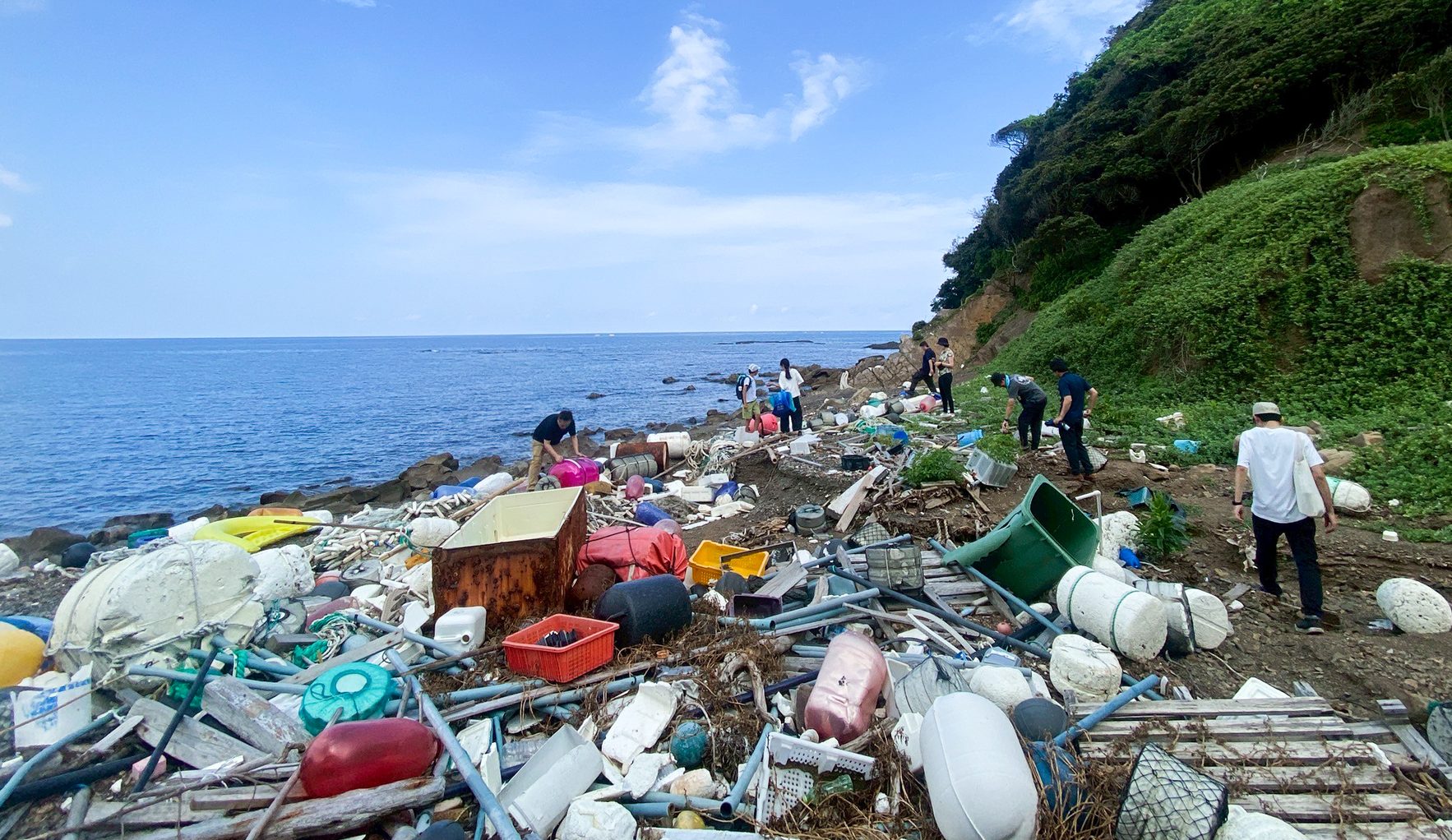
How much does Tsushima City budget for collecting and disposing of marine litter?
Tsushima City in Nagasaki Prefecture has allocated JPY 310 m (3 oku 1,000 man yen) in its FY2026 initial budget to the Coastal Drifted Litter Regional Measures Programme: JPY 268.2 m for collecting and disposing of drifting and washed-up litter, JPY 17.49 m for monitoring surveys and JPY 24.31 m for prevention (Tsushima City, FY2026 budget, main projects (sanitation)). The budget was JPY 300 m in FY2023 and FY2024 and JPY 310 m in FY2025. The city describes the project as properly disposing of litter collected by local residents and others while running prevention work aimed at Japan and abroad, and says part of the collected litter (expanded polystyrene and hard plastic) is reduced to pellets and chips to cut disposal costs.
Karatsu Farm & Food made this page as part of the Karatsu Data Bank. It sets out who pays how much to pick up, move and dispose of litter washed up on the coast, using figures exactly as published by the Ministry of the Environment, the Ministry of Finance, Tsushima City and Saga Prefecture, without conclusions or evaluation. Where we have sorted or calculated, we say so. National budget trends and cost per tonne are on Ocean Plastic Recycling in Numbers; national collection and participant trends are on Beach Clean-ups in Numbers.
| Fiscal year | Programme budget | Collection and disposal of drifting and washed-up litter | Monitoring surveys | Prevention |
|---|---|---|---|---|
| FY2023 | JPY 300 m | JPY 253.03 m | JPY 13 m | JPY 33.97 m |
| FY2024 | JPY 300 m | JPY 262.44 m | JPY 15.90 m | JPY 21.66 m |
| FY2025 | JPY 310 m | JPY 268.20 m | JPY 17.49 m | JPY 24.31 m |
| FY2026 | JPY 310 m | JPY 268.20 m | JPY 17.49 m | JPY 24.31 m |
How much litter washes up on Tsushima, and how much is collected?
Tsushima City's 2nd Environmental Basic Plan (2022) says that location, currents, seasonal winds and terrain combine to bring a huge amount of marine litter, mainly from abroad; it estimates about 20,000 to 30,000 m3 a year and says about 8,000 m3 is collected each year using the national subsidy (Tsushima City, 2nd Environmental Basic Plan, chapter 2 (zero waste)). The city's FY2024 monitoring survey estimates the annual amount washing up on the whole island at 31,500 m3, or 3,561 t; by volume, natural wood (33%), plastics (18%) and expanded polystyrene (14%) are the largest shares. The same survey estimates that 33% of the annual amount (10,444 m3) drifts back out to sea (Tsushima City, FY2024 beach litter monitoring survey, summary report).
| Item | Value | Date and source |
|---|---|---|
| Litter washing up each year (estimate) | about 20,000 to 30,000 m3 | Tsushima City, 2nd Environmental Basic Plan (2022) |
| Collected each year | about 8,000 m3 | same |
| Annual amount washing up on the whole island (estimate) | 31,500 m3 / 3,561 t | FY2024 monitoring survey (Tsushima City) |
| Annual amount drifting back out (estimate) | 10,444 m3 / 668 t | same |
A 2017 paper in the Journal of the JIME records past costs in Tsushima: in FY2010 and FY2011 about JPY 800 m, fully funded by the national treasury, collected about 22,400 m3; FY2013 and FY2014 cost about JPY 1 bn (100% subsidy). Subsidies of about JPY 280 m in FY2015 and JPY 290 m in FY2016 came with the rate cut to 95% and 90%, and the city paid JPY 14 m in FY2015 and JPY 31 m in FY2016 from its general revenue (Journal of the JIME, Vol. 52, No. 5 (paper on drifted litter in Tsushima)).
Who pays for collecting marine litter across Japan?
According to the Ministry of the Environment's implementation survey, spending on beach litter measures across Japan in FY2024 was JPY 5,057,671 thousand (about JPY 5.06 bn): JPY 3,311,092 thousand from the national treasury, JPY 1,219,279 thousand from prefectures and JPY 571,058 thousand from municipalities. 35,570.7 t was collected. Prefectural projects accounted for JPY 2,642,040 thousand and 18,864.3 t, municipal projects (including joint bodies) JPY 2,415,631 thousand and 16,706.3 t (Ministry of the Environment, survey on implementation of the Marine Litter Act (FY2024 results)).
| Implementing body | Spending | National treasury | Prefectures | Municipalities | Collected |
|---|---|---|---|---|---|
| Prefectural projects | JPY 2,642,040 k | JPY 1,480,701 k | JPY 1,169,190 k | JPY 10,891 k | 18,864.3 t |
| Municipal projects | JPY 2,415,631 k | JPY 1,830,391 k | JPY 50,089 k | JPY 560,167 k | 16,706.3 t |
| Japan total | JPY 5,057,671 k | JPY 3,311,092 k | JPY 1,219,279 k | JPY 571,058 k | 35,570.7 t |
| of which collection by fishers | JPY 100,460 k | JPY 76,323 k | JPY 15,267 k | JPY 9,928 k | 636 t |
How is the national subsidy shared out to local governments?
Under Article 29 of the Marine Litter Act, the national government subsidises collection, disposal, prevention and regional plans by prefectures and municipalities through the Coastal Drifted Litter Regional Measures Programme. The subsidy rate is 9/10 to 7/10 for collection, disposal and prevention (raised for remote islands, depopulated areas and peninsulas) and 1/2 for regional plans (prefectures only). Prefectures receive the subsidy and municipal projects are funded indirectly through them. The ministry's programme sheet gives a FY2025 supplementary budget of JPY 3,800 m and says the programme has recently run at about JPY 3,695 m a year (JPY 170 m initial plus JPY 3,525 m supplementary) (Ministry of the Environment, Coastal Drifted Litter Regional Measures Programme (FY2025 supplementary budget sheet)). The FY2021 supplementary budget sheet adds that 80% of the local share is covered by special local allocation tax (Ministry of the Environment, programme sheet (FY2021 supplementary budget proposal)).
On how amounts are set, the Ministry of Finance's budget execution review says the ministry decides each grant by adjusting from a base amount set with reference to the previous year's grant and recent spending, against each local government's request (Ministry of Finance, FY2023 budget execution review, sheet 28). As an example of the flow, under the FY2021 first supplementary budget (JPY 7,888 m) JPY 4,859 m went from the national government to 41 prefectures, and prefectures passed on 528 indirect grants totalling JPY 2,058 m to municipalities (Ministry of the Environment, disclosure on budget execution (general account)).
| Stage | Number | Amount | Year |
|---|---|---|---|
| Budget (FY2021 first supplementary) | - | JPY 7,888 m | FY2021 |
| National government to prefectures | 41 | JPY 4,859 m | same |
| Prefectures to municipalities (indirect) | 528 | JPY 2,058 m | same |
How much is collected under the programme in Saga and Nagasaki?
According to the Ministry of the Environment's FY2025 report, washed-up litter collected under the programme in FY2024 was 425.2 t in Saga (294 clean-ups, 1,011.4 km of coast in total) and 2,300.4 t in Nagasaki (635 clean-ups, 868.9 km). Nagasaki's total is about 5.4 times Saga's (our calculation). Saga also collected 92.0 t of floating and seabed litter in 9 operations (Ministry of the Environment, FY2025 report on marine litter and efficient collection).
| Fiscal year | Saga clean-ups | Saga collected | Nagasaki clean-ups | Nagasaki collected |
|---|---|---|---|---|
| FY2018 | 71 | 365 t | 496 | 1,711 t |
| FY2019 | 85 | 191 t | 544 | 2,098 t |
| FY2020 | 115 | 657 t | 598 | 2,300 t |
| FY2021 | 108 | 743 t | 552 | 2,199 t |
| FY2022 | 102 | 356 t | 563 | 2,436 t |
| FY2023 | 295 | 282 t | 553 | 2,333 t |
| FY2024 | 294 | 425.2 t | 635 | 2,300.4 t |
How are Karatsu's beaches treated in Saga Prefecture's plan?
Saga Prefecture's Regional Plan for Coastal Drifted Litter (September 2025) designates the Matsuura coast (Karatsu, Genkai and Imari) as a priority area, covering the coastline within Genkai Quasi-National Park among others. Of the 10 "model area beaches" in the prefecture, where local participation comes close to the management the plan aims for, 7 are in Karatsu: Higashi-no-hama to Hamasaki, Nishi-no-hama, Kotari, Ouka, Tategami, Otomo and Hado in Chinzei (Saga Prefecture, Regional Plan for Coastal Drifted Litter (September 2025)). The ministry's beach litter composition survey uses Kotari beach in Karatsu as Saga's survey site (Ministry of the Environment, beach litter composition survey summary (FY2024)).
Beach clean-ups we have organised or co-organised in Karatsu have had 3,313 participants in total (as of April 2026, our own records).
Is anyone turning Tsushima's marine litter into something beyond waste?
The Tsushima WAVE Project, which we direct, turns marine plastic collected on Tsushima's beaches into material for art and products.
FAQ
Q1. How much does collecting and disposing of marine litter cost in Japan?
The Ministry of the Environment's implementation survey puts national spending on beach litter measures in FY2024 at JPY 5,057,671 thousand (about JPY 5.06 bn), with 35,570.7 t collected. The national treasury bore JPY 3,311,092 thousand, prefectures JPY 1,219,279 thousand and municipalities JPY 571,058 thousand.
Q2. How much does Tsushima City budget for marine litter?
Tsushima City's FY2026 initial budget allocates JPY 310 m to the Coastal Drifted Litter Regional Measures Programme: JPY 268.2 m for collecting and disposing of drifting and washed-up litter, JPY 17.49 m for monitoring surveys and JPY 24.31 m for prevention. The budget was JPY 300 m in FY2023 and FY2024 and JPY 310 m in FY2025.
Q3. Is there a national subsidy for collecting marine litter?
Yes: the Ministry of the Environment's Coastal Drifted Litter Regional Measures Programme. Prefectures receive the subsidy and municipal projects are funded indirectly through them. The subsidy rate is 9/10 to 7/10 for collection, disposal and prevention (raised for remote islands, depopulated areas and peninsulas) and 1/2 for regional plans. The FY2025 supplementary budget was JPY 3,800 m.
Q4. How much marine litter is collected in Saga Prefecture?
Under the national programme, Saga collected 425.2 t of washed-up litter in FY2024 (294 clean-ups). Since FY2018 the highest year was FY2021 with 743 t. Nagasaki collected 2,300.4 t in FY2024.
Q5. How much litter washes up on Tsushima?
Tsushima City's 2nd Environmental Basic Plan (2022) estimates about 20,000 to 30,000 m3 a year and says about 8,000 m3 is collected each year. The FY2024 monitoring survey estimates the annual amount washing up on the whole island at 31,500 m3, or 3,561 t.
Sources
| Document | Publisher | Date | URL | Retrieved |
|---|---|---|---|---|
| Tsushima City, FY2026 budget, main projects (sanitation) | Tsushima City | 2026-05 (page update) | https://www.city.tsushima.nagasaki.jp/material/files/group/4/06eiseihi08.pdf | 2026-11-06 |
| Tsushima City, FY2025 budget, main projects (sanitation) | Tsushima City | FY2025 | https://www.city.tsushima.nagasaki.jp/material/files/group/4/06eiseihi.pdf | 2026-11-06 |
| Tsushima City, FY2024 budget, main projects (sanitation) | Tsushima City | FY2024 | https://www.city.tsushima.nagasaki.jp/material/files/group/4/06-R6.pdf | 2026-11-06 |
| Tsushima City, FY2023 budget, main projects (sanitation) | Tsushima City | FY2023 | https://www.city.tsushima.nagasaki.jp/material/files/group/4/R05-06.pdf | 2026-11-06 |
| Tsushima City, 2nd Environmental Basic Plan, chapter 2 (zero waste) | Tsushima City | 2022 | https://www.city.tsushima.nagasaki.jp/material/files/group/69/chapter2_2_5.pdf | 2026-11-06 |
| Tsushima City, FY2024 beach litter monitoring survey, summary report | Tsushima City | 2025 | https://tsushima-mltic.com/wp-content/uploads/2025/04/%E4%BB%A4%E5%92%8C6%E5%B9%B4%E5%BA%A6%E5%AF%BE%E9%A6%AC%E5%B8%82%E6%B5%B7%E5%B2%B8%E6%BC%82%E7%9D%80%E7%89%A9%E3%83%A2%E3%83%8B%E3%82%BF%E3%83%AA%E3%83%B3%E3%82%B0%E8%AA%BF%E6%9F%BB%E6%A5%AD%E5%8B%99%E5%A7%94%E8%A8%97%E3%80%80%E8%AA%BF%E6%9F%BB%E5%A0%B1%E5%91%8A%E6%9B%B8%E3%80%90%E6%A6%82%E8%A6%81%E7%89%88%E3%80%91.pdf | 2026-11-06 |
| Journal of the JIME, Vol. 52, No. 5 (paper on drifted litter in Tsushima) | JIME | 2017 | https://www.jstage.jst.go.jp/article/jime/52/5/52_594/_pdf | 2026-11-06 |
| Ministry of the Environment, survey on implementation of the Marine Litter Act (FY2024 results) | Ministry of the Environment | 2026 (FY2024 results) | https://www.env.go.jp/content/000396901.pdf | 2026-11-06 |
| Ministry of the Environment, Coastal Drifted Litter Regional Measures Programme (FY2025 supplementary budget sheet) | Ministry of the Environment | FY2025 | https://www.env.go.jp/content/000357441.pdf | 2026-11-06 |
| Ministry of the Environment, programme sheet (FY2021 supplementary budget proposal) | Ministry of the Environment | FY2021 | https://www.env.go.jp/content/900470334.pdf | 2026-11-06 |
| Ministry of Finance, FY2023 budget execution review, sheet 28 | Ministry of Finance | FY2023 | https://www.mof.go.jp/policy/budget/topics/budget_execution_audit/fy2023/sy0506/28.pdf | 2026-11-06 |
| Ministry of the Environment, disclosure on budget execution (general account) | Ministry of the Environment | - | https://www.env.go.jp/content/000254186.pdf | 2026-11-06 |
| Ministry of the Environment, FY2025 report on marine litter and efficient collection | Ministry of the Environment | 2026-03 | https://www.env.go.jp/content/000318995.pdf | 2026-11-06 |
| Saga Prefecture, Regional Plan for Coastal Drifted Litter (September 2025) | Saga Prefecture | 2025-09 | https://www.pref.saga.lg.jp/kiji00352458/3_52458_367947_up_2no2qav5.pdf | 2026-11-06 |
| Ministry of the Environment, beach litter composition survey summary (FY2024) | Ministry of the Environment | FY2024 | https://www.env.go.jp/content/000396903.pdf | 2026-11-06 |
Notes on reading the figures
Tsushima figures are initial budgets and exclude supplementary budgets and actual spending. The implementation survey's spending combines national subsidy projects with prefectural and municipal projects of their own, and the shares do not add up to the total (as published). The ministry reports collection by weight (t) and Tsushima City by volume (m3), so they cannot be compared directly. Saga and Nagasaki figures cover the national programme only and exclude litter collected independently by volunteers and private groups. Annual amounts washing up are island-wide estimates scaled up from survey sites.
What this page does not cover
Grants to each prefecture (we could not confirm them in primary sources this time), the budgets and spending of Saga Prefecture and Karatsu City on marine litter (not confirmed in primary sources this time), Nagasaki Prefecture's own budget, cost per tonne (see Ocean Plastic Recycling in Numbers), the composition of the litter, or any evaluation of individual operators or groups.
Citing this page and enquiries
To cite these figures, or to ask about finding local data, use our contact page or info@karatsu-f-f.com.
About this page
By Hiroaki Kojima (Vice Director, Karatsu Farm & Food) / Contact: info@karatsu-f-f.com (contact page) / Published 6 November 2026 / Markdown: umigomi-cost-data.mdThis page is made together with AI. See this data bank and AI for how.
Related links
▶ Karatsu Data Bank
▶ Ocean Plastic Recycling in Numbers
▶ Beach Clean-ups in Numbers
▶ Tsushima WAVE Project
▶ 日本語版