
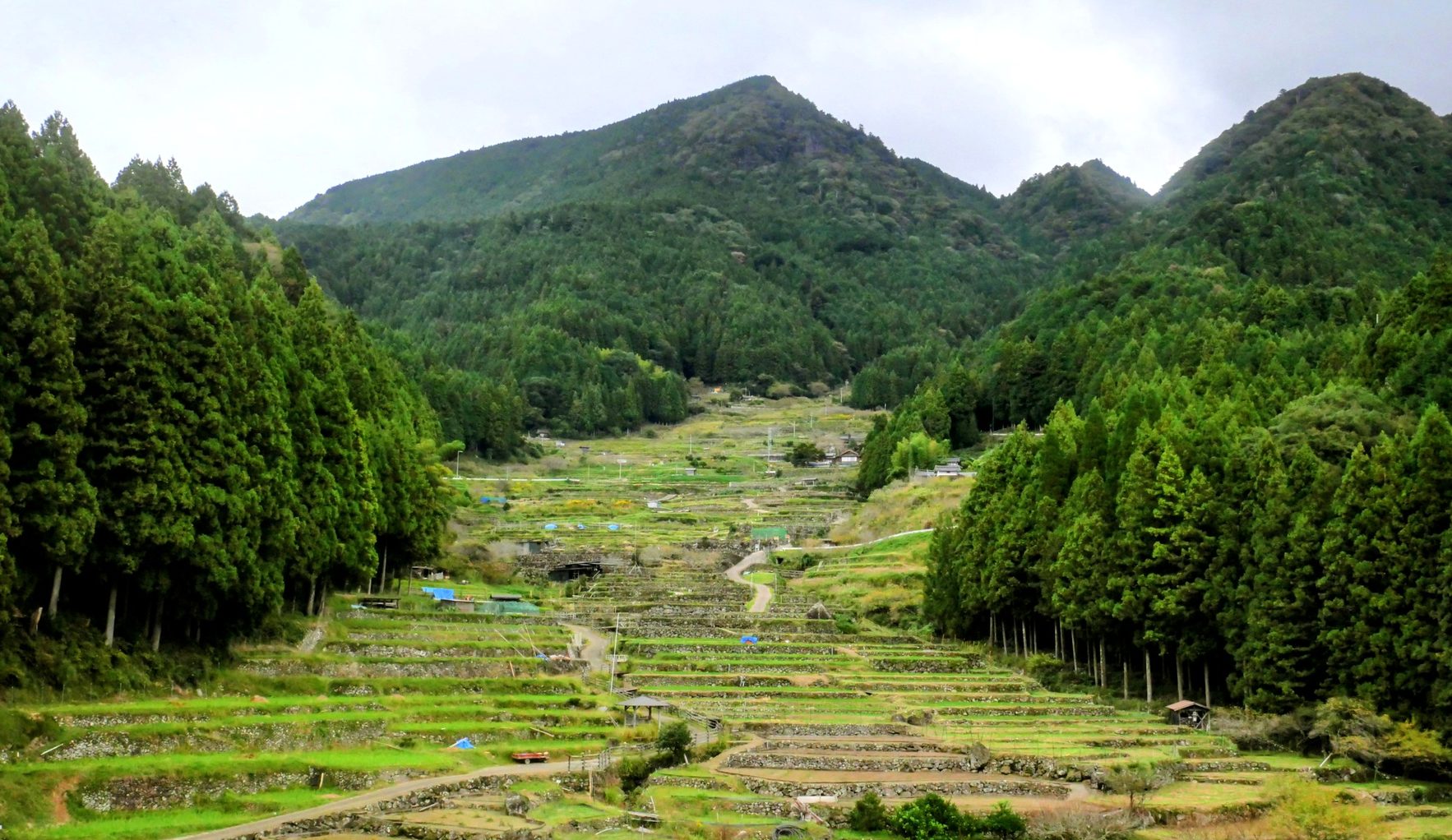
Where are Japan's rice terraces? (Tsunagu Tanada Isan, 2022)
The Ministry of Agriculture, Forestry and Fisheries (MAFF) certified 271 rice terrace sites as Tsunagu Tanada Isan ("heritage terraces to pass on") on 25 March 2022. By prefecture, Niigata has the most (36), followed by Kumamoto (17), Nagano (15), Miyazaki (13) and Shimane (11); Saga has 10, tied with Oita for 6th (MAFF, list of certified terraces, counted and sorted by us). The 1999 list of Japan's Top 100 Rice Terraces (Tanada Hyakusen) has 134 sites, with Nagano the most (16) and 6 in Saga (MAFF, Top 100 Rice Terraces, counted by us).
This page was made by Karatsu Farm & Food as part of the Karatsu Data Bank. It looks at the number and area of rice terraces in the world (agricultural heritage and World Heritage terraces, rice area by country), Japan (definition, national schemes, a ranking of 47 prefectures), Saga (its certified terraces) and Karatsu (the Warabino terraces and our work). Abandoned farmland figures are on abandoned farmland by prefecture and Karatsu's farming figures on Karatsu agriculture data.
| Question | Figure | Period | Source |
|---|---|---|---|
| Definition (MAFF) | stepped paddies on slopes of 1 in 20 or steeper | MAFF | |
| Tsunagu Tanada Isan | 271 sites (44 prefectures) | certified 25 March 2022 | MAFF (prefectures counted by us) |
| Most sites | Niigata, 36 | 2022 | MAFF (sorted by us) |
| Saga | 10 sites (6th) | 2022 | MAFF (sorted by us) |
| Top 100 Rice Terraces | 134 sites (117 municipalities) | certified July 1999 | MAFF |
| Designated terrace areas (Terrace Areas Promotion Act) | 751 areas (42 prefectures) | as of August 2026 | Cabinet Office |
| Warabino terraces (Ochi, Karatsu) | Important Cultural Landscape | 28 July 2008 | Agency for Cultural Affairs |
Rice terraces in the world: agricultural heritage and World Heritage
FAO's Globally Important Agricultural Heritage Systems (GIAHS) with rice terraces in their names are Hani in China (2010), Ifugao in the Philippines (2011), Cheongsando in Korea (2014) and the terraces of southern China's mountains and hills (2018) (FAO and the other site pages). The Ifugao terraces lie in mountains at 800-1,500 metres (FAO).
| GIAHS site | Country | Designated | Source |
|---|---|---|---|
| Hani Rice Terraces | China | 2010 | FAO |
| Ifugao Rice Terraces | Philippines | 2011 | FAO |
| Traditional Gudeuljang Irrigated Rice Terraces in Cheongsando | Korea | 2014 | FAO |
| Rice Terraces in Southern Mountainous and Hilly Areas | China | 2018 | FAO |
| World Heritage property | Country | Inscribed | Property area | Source |
|---|---|---|---|---|
| Rice Terraces of the Philippine Cordilleras | Philippines | 1995 | not stated on the page | UNESCO |
| Cultural Landscape of Honghe Hani Rice Terraces | China | 2013 | 16,603.22 ha (buffer zone 29,501.01 ha) | UNESCO |
| Cultural Landscape of Bali Province: the Subak System | Indonesia | 2012 | 19,519.9 ha (buffer zone 1,454.8 ha) | UNESCO |
For rice growing as a whole, terraces included, FAOSTAT gives 172,414,425 ha of rice harvested worldwide in 2024: India 50,511,930 ha and mainland China 29,006,900 ha. Japan had 1,458,000 ha (0.85% of the world, our calculation) and was 16th (FAO, FAOSTAT, sorted by us).
| Rank | Country | Rice area harvested (ha, 2024) | Share of world | Flag |
|---|---|---|---|---|
| 1 | India | 50,511,930 | 29.3% | A |
| 2 | China, mainland | 29,006,900 | 16.8% | A |
| 3 | Bangladesh | 11,448,789 | 6.6% | A |
| 4 | Thailand | 11,248,558 | 6.5% | A |
| 5 | Indonesia | 10,046,135 | 5.8% | A |
| 6 | Viet Nam | 7,063,212 | 4.1% | A |
| 7 | Myanmar | 7,016,173 | 4.1% | I |
| 8 | Philippines | 4,645,921 | 2.7% | A |
| 9 | Nigeria | 4,572,900 | 2.7% | A |
| 10 | Pakistan | 3,899,215 | 2.3% | A |
| 16 | Japan | 1,458,000 | 0.85% | E |
| World | 172,414,425 | 100.0% | A |
What is a tanada? Japan's definition and national schemes
MAFF describes tanada (rice terraces) as paddies built in steps on hillsides or valley slopes with a gradient of 1 in 20 or steeper (MAFF, promotion of terrace areas). The Terrace Areas Promotion Act was passed in June 2019 and took effect on 16 August 2019. To be designated, an area (a municipality as of 1 February 1950) needs at least 1 ha of contiguous terraces with a gradient of 1 in 20 or steeper (Cabinet Office and MAFF, explanatory guide, pp. 2 and 7).
National certifications of terraces are the Top 100 Rice Terraces of July 1999 (134 sites in 117 municipalities; MAFF, Top 100 Rice Terraces leaflet, p. 2) and Tsunagu Tanada Isan of 25 March 2022 (271 sites) (MAFF, implementation of Tsunagu Tanada Isan,MAFF, Tsunagu Tanada Isan). The name Tsunagu Tanada Isan was chosen through a public call in September 2021 that drew 473 entries (MAFF).
Designated terrace areas, 2020-2026
| Period | Designated terrace areas | Municipalities |
|---|---|---|
| End of FY2020 | 629 | 185 |
| End of FY2021 | 698 | 215 |
| End of FY2022 | 711 | 235 |
| August 2026 | 751 | not covered here |
Terrace area: 220,000 ha and 138,000 ha (different definitions, not comparable)
| Definition | Area | Year | Original survey |
|---|---|---|---|
| Paddies on slopes of 1 in 20 or steeper | 220,000 ha | 1993 | MAFF survey of sloping paddies |
| Census terraces (paddies built along contours on slopes, with level surfaces that look like shelves) | 138,000 ha (54,000 sites) | 2005 | 2005 Census of Agriculture and Forestry |
Of the 220,000 ha in 1993, 20,000 ha (9.8%) were plots of 20 a or more, 40,000 ha (17.0%) were under 20 a and 160,000 ha (73.2%) were irregular in shape (MAFF).
Rice terraces by prefecture (Tsunagu Tanada Isan and Top 100)
| Rank | Prefecture | Tsunagu Tanada Isan (sites, 2022) | Share of Japan | Top 100 Rice Terraces (sites, 1999) | Top 100 rank |
|---|---|---|---|---|---|
| 1 | Niigata | 36 | 13.3% | 7 | 4 |
| 2 | Kumamoto | 17 | 6.3% | 11 | 2 |
| 3 | Nagano | 15 | 5.5% | 16 | 1 |
| 4 | Miyazaki | 13 | 4.8% | 11 | 2 |
| 5 | Shimane | 11 | 4.1% | 7 | 4 |
| 6 | Saga | 10 | 3.7% | 6 | 6 |
| 6 | Oita | 10 | 3.7% | 6 | 6 |
| 8 | Yamagata | 9 | 3.3% | 3 | 14 |
| 8 | Gifu | 9 | 3.3% | 5 | 9 |
| 8 | Shizuoka | 9 | 3.3% | 5 | 9 |
| 8 | Nagasaki | 9 | 3.3% | 6 | 6 |
| 12 | Wakayama | 8 | 3.0% | 1 | 28 |
| 12 | Yamaguchi | 8 | 3.0% | 1 | 28 |
| 14 | Ishikawa | 7 | 2.6% | 3 | 14 |
| 14 | Shiga | 7 | 2.6% | 1 | 28 |
| 14 | Hyogo | 7 | 2.6% | 4 | 11 |
| 14 | Okayama | 7 | 2.6% | 4 | 11 |
| 18 | Toyama | 5 | 1.8% | 2 | 19 |
| 18 | Osaka | 5 | 1.8% | 2 | 19 |
| 18 | Tokushima | 5 | 1.8% | 2 | 19 |
| 18 | Ehime | 5 | 1.8% | 3 | 14 |
| 18 | Fukuoka | 5 | 1.8% | 4 | 11 |
| 23 | Kyoto | 4 | 1.5% | 2 | 19 |
| 23 | Hiroshima | 4 | 1.5% | 1 | 28 |
| 23 | Kagawa | 4 | 1.5% | 1 | 28 |
| 23 | Kochi | 4 | 1.5% | 1 | 28 |
| 23 | Kagoshima | 4 | 1.5% | 3 | 14 |
| 28 | Hokkaido | 3 | 1.1% | 0 | - |
| 28 | Iwate | 3 | 1.1% | 1 | 28 |
| 28 | Fukushima | 3 | 1.1% | 0 | - |
| 28 | Mie | 3 | 1.1% | 3 | 14 |
| 28 | Tottori | 3 | 1.1% | 2 | 19 |
| 33 | Miyagi | 2 | 0.7% | 2 | 19 |
| 33 | Tochigi | 2 | 0.7% | 2 | 19 |
| 33 | Chiba | 2 | 0.7% | 1 | 28 |
| 33 | Fukui | 2 | 0.7% | 2 | 19 |
| 33 | Yamanashi | 2 | 0.7% | 0 | - |
| 33 | Aichi | 2 | 0.7% | 2 | 19 |
| 33 | Nara | 2 | 0.7% | 1 | 28 |
| 40 | Aomori | 1 | 0.4% | 0 | - |
| 40 | Akita | 1 | 0.4% | 0 | - |
| 40 | Gunma | 1 | 0.4% | 0 | - |
| 40 | Saitama | 1 | 0.4% | 0 | - |
| 40 | Kanagawa | 1 | 0.4% | 0 | - |
| 45 | Ibaraki | 0 | 0.0% | 0 | - |
| 45 | Tokyo | 0 | 0.0% | 0 | - |
| 45 | Okinawa | 0 | 0.0% | 0 | - |
| Japan | 271 | 100.0% | 134 |
Rice terraces in Saga (10 heritage terraces, 6 of the Top 100)
Saga has 10 Tsunagu Tanada Isan, behind Kumamoto (17) and Miyazaki (13) in Kyushu (Oita also has 10). The seven Kyushu prefectures have 68 together, 25.1% of Japan (MAFF, our calculation). Three are in Karatsu: Warabino, Datake and Oura.
| Municipality | Terraces | Tsunagu Tanada Isan (2022) | Top 100 (1999) |
|---|---|---|---|
| Karatsu City | Warabino | yes | yes (Ochi) |
| Karatsu City | Datake | yes | |
| Karatsu City | Oura | yes | yes (Hizen) |
| Taku City | Hirano | yes | |
| Imari City | Nakata | yes | |
| Imari City | Kawachino | yes | |
| Takeo City | Kawachi | yes | |
| Ogi City | Eriyama | yes | yes (Ogi) |
| Genkai Town | Hamanoura | yes | yes (Genkai) |
| Arita Town | Take | yes | yes (Nishi-Arita) |
| - | Nishinotani | yes (Fuji) |
The only Important Cultural Landscape in Saga is the Warabino terraces in Ochi, Karatsu (Saga Prefecture, national selections (cultural landscapes)). Japan had 74 Important Cultural Landscapes as of the official gazette of 17 February 2026 (Agency for Cultural Affairs, cultural landscapes).
Terraces in Karatsu: the Warabino terraces (Ochi)
The Warabino terraces were selected as an Important Cultural Landscape on 28 July 2008, and are on both the 1999 Top 100 and the 2022 Tsunagu Tanada Isan. Sources give different areas: the Agency for Cultural Affairs and Saga Prefecture say about 36 ha, while the Tsunagu Tanada Isan site sheet says 59.5 ha. The boundaries appear to differ, but the sources do not say why.
| Source | Area | Stone wall height | Other details | Link |
|---|---|---|---|---|
| Agency for Cultural Affairs, Cultural Heritage Online | about 36 ha | 3-5 m on average, up to 8.5 m | Important Cultural Landscape, 28 July 2008; made up of Warabino and Ike districts, with two reservoirs in Ike | Agency for Cultural Affairs |
| Saga Prefecture, national selections | about 36 ha | 3-5 m on average, up to 8.5 m | selected 28 July 2008 | Saga Prefecture |
| MAFF, Tsunagu Tanada Isan site sheet (No. 209) | 59.5 ha | 8.5 m | Hirayama-kami, Ochi, Karatsu (Warabino); stone-walled | MAFF |
| MAFF, Midori Digital Museum | about 36 ha cultivated | 180-420 m above sea level, 700 plots | MAFF |
An example from Karatsu (our work)
We conserve the satoyama rice paddies and water channels of Yokomakura (36.67 ha), a Nature Symbiosis Site certified by the Ministry of the Environment in Ochi, Karatsu, the same area as the Warabino terraces, together with local residents (nature positive and Yokomakura). On 30 June 2026 we planted the Nature Symbiosis Site rice in the Yokomakura paddies. National figures for Nature Symbiosis Sites are on Nature Symbiosis Site data. For site visits, training or corporate partnerships, see "Citing this page and enquiries" below.
Frequently asked questions
Q1. What is a tanada (rice terrace)?
MAFF describes rice terraces as paddies built in steps on hillsides or valley slopes with a gradient of 1 in 20 or steeper. The 2005 Census counted paddies built along contours on slopes, with level surfaces that look like shelves.
Q2. How many sites are on Japan's Top 100 Rice Terraces and Tsunagu Tanada Isan lists?
The Top 100 Rice Terraces (July 1999) has 134 sites in 117 municipalities; Tsunagu Tanada Isan (25 March 2022) has 271 sites (MAFF).
Q3. Which prefectures have the most rice terraces?
By Tsunagu Tanada Isan sites: 1 Niigata 36, 2 Kumamoto 17, 3 Nagano 15, 4 Miyazaki 13, 5 Shimane 11. On the Top 100, Nagano has the most with 16 (MAFF lists counted and sorted by us).
Q4. How many are in Saga?
10 Tsunagu Tanada Isan (6th, tied with Oita) and 6 of the Top 100. Karatsu's three heritage terraces are Warabino, Datake and Oura.
Q5. How large are the Warabino terraces?
Sources differ: about 36 ha according to the Agency for Cultural Affairs and Saga Prefecture, 59.5 ha on the Tsunagu Tanada Isan site sheet. MAFF's Midori Digital Museum gives about 36 ha cultivated in 700 plots at 180-420 m.
Q6. How much rice terrace area does Japan have?
220,000 ha of paddies on slopes of 1 in 20 or steeper in 1993, and 138,000 ha (54,000 sites) of terraces in the 2005 Census. The definitions differ, so the two cannot be compared.
Q7. Which rice terraces are World Heritage or GIAHS sites?
World Heritage: the Philippine Cordilleras (1995), Bali's subak (2012) and Honghe Hani in China (2013). GIAHS: Hani, China (2010), Ifugao, Philippines (2011), Cheongsando, Korea (2014) and southern China's terraces (2018).
Q8. Is anyone conserving satoyama paddies in Karatsu?
We conserve the satoyama paddies and water channels of the Yokomakura Nature Symbiosis Site (36.67 ha) in Ochi, Karatsu, with local residents, and planted its rice on 30 June 2026.
Source register
| Document | Publisher | Date | URL | Accessed |
|---|---|---|---|---|
| Promotion of terrace areas | MAFF | updated as needed | https://www.maff.go.jp/j/nousin/tanada/tanada.html | 2026-11-20 |
| Explanatory guide to the promotion of terrace areas | Cabinet Office and MAFF | 2020 | https://www.maff.go.jp/j/nousin/tanada/attach/pdf/tanada-9.pdf | 2026-11-20 |
| Designated terrace areas | Cabinet Office, Regional Revitalization Promotion Office | as of 2026-08 | https://www.chisou.go.jp/tiiki/tanada/shitei/index.html | 2026-11-20 |
| Direct payments for hilly and mountainous areas (paper 2) | MAFF | 2023-12 | https://www.maff.go.jp/j/nousin/tyusan/siharai_seido/s_daisan_5ki/attach/pdf/8-3.pdf | 2026-11-20 |
| Certification of Tsunagu Tanada Isan | MAFF | 2022-03-25 | https://www.maff.go.jp/j/nousin/tanada/nintei.html | 2026-11-20 |
| List of certified Tsunagu Tanada Isan | MAFF | 2022-03-25 | https://www.maff.go.jp/j/nousin/tanada/attach/pdf/nintei-1.pdf | 2026-11-20 |
| Tsunagu Tanada Isan site sheet: Warabino (No. 209) | MAFF | 2022 | https://www.maff.go.jp/j/nousin/tanada/attach/pdf/nintei-210.pdf | 2026-11-20 |
| Implementation of Tsunagu Tanada Isan (successor to the Top 100 Rice Terraces) | MAFF | updated as needed | https://www.maff.go.jp/j/nousin/tanada/tanadasen.html | 2026-11-20 |
| Top 100 Rice Terraces leaflet | MAFF | 1999 | https://www.maff.go.jp/j/nousin/tanada/attach/pdf/tanadasen-1.pdf | 2026-11-20 |
| Hilly and mountainous areas and their farming (rural subcommittee papers) | MAFF | 1997-09 | https://www.maff.go.jp/j/study/nouson_kihon/pdf/data_nouson4.pdf | 2026-11-20 |
| National selections (cultural landscapes) | Saga Prefecture | updated as needed | https://www.pref.saga.lg.jp/kiji0031742/index.html | 2026-11-20 |
| Cultural Heritage Online: Warabino terraces | Agency for Cultural Affairs | updated as needed | https://online.bunka.go.jp/heritages/detail/140384 | 2026-11-20 |
| Cultural landscapes | Agency for Cultural Affairs | as of 2026-02 | https://www.bunka.go.jp/seisaku/bunkazai/shokai/keikan/ | 2026-11-20 |
| Midori Digital Museum: Warabino stone-walled terraces | MAFF | updated as needed | https://www.maff.go.jp/j/nousin/sekkei/museum/m_kakuti/55_warabi/index.html | 2026-11-20 |
| GIAHS: Hani Rice Terraces | FAO | updated as needed | https://www.fao.org/giahs/giahs-around-the-world/china-hani-rice-terraces/en | 2026-11-20 |
| GIAHS: Ifugao Rice Terraces | FAO | updated as needed | https://www.fao.org/giahs/giahs-around-the-world/philippines-ifugao-rice-terraces-system/en | 2026-11-20 |
| GIAHS: Traditional Gudeuljang Irrigated Rice Terraces in Cheongsando | FAO | updated as needed | https://www.fao.org/giahs/giahs-around-the-world/korea-cheongsando-rice-terraces-system/en | 2026-11-20 |
| GIAHS: Rice Terraces in Southern Mountainous and Hilly Areas | FAO | updated as needed | https://www.fao.org/giahs/giahs-around-the-world/china-rice-terraces-mountainous/en | 2026-11-20 |
| Rice Terraces of the Philippine Cordilleras | UNESCO World Heritage Centre | updated as needed | https://whc.unesco.org/en/list/722/ | 2026-11-20 |
| Cultural Landscape of Honghe Hani Rice Terraces | UNESCO World Heritage Centre | updated as needed | https://whc.unesco.org/en/list/1111/ | 2026-11-20 |
| Cultural Landscape of Bali Province: the Subak System as a Manifestation of the Tri Hita Karana Philosophy | UNESCO World Heritage Centre | updated as needed | https://whc.unesco.org/en/list/1194/ | 2026-11-20 |
| FAOSTAT Crops and livestock products (bulk download) | FAO | updated 2025-12-31 | https://bulks-faostat.fao.org/production/Production_Crops_Livestock_E_All_Data.zip | 2026-11-20 |
Notes on reading the figures
Prefectural counts of Tsunagu Tanada Isan and the Top 100 are our counts of MAFF's lists by location; ranks and shares are our sorting and calculation, not rankings published by MAFF. A second round of Tsunagu Tanada Isan could not be confirmed on MAFF's pages. Designated terrace areas by prefecture are not shown because the prefectural lists have different dates and do not add up to the national total. The 220,000 ha (1993) and 138,000 ha (2005) use different definitions and cannot be compared. The Warabino terraces are given as about 36 ha and 59.5 ha in different sources, apparently because the boundaries differ. World Heritage areas are property boundaries, not terrace area alone. Japan's FAOSTAT value is an FAO estimate.
What this page does not cover
Abandoned farmland by prefecture is on abandoned farmland by prefecture, Karatsu's farms and farmland on Karatsu agriculture data, visitor flows around places such as the Hamanoura terraces on Saga tourist spots data, rice prices on rice price data (Japanese) and green infrastructure including terraces on green infrastructure data. This page does not cover yields or prices of terrace rice, terrace ownership schemes or terrace area by municipality.
Citing this page and enquiries
To cite figures from this page, or to ask about site visits, training or corporate partnerships at Yokomakura, please use our contact page or write to info@karatsu-f-f.com.
About this page
By Hiroaki Kojima (Vice Director, Karatsu Farm & Food) / Contact: info@karatsu-f-f.com (contact page) / Published: 20 November 2026 / Markdown: tanada-data.mdThis page is made together with AI. See this data bank and AI for how.
Related links
▶ Karatsu Data Bank
▶ Nature positive and Yokomakura
▶ Nature Symbiosis Site data
▶ Abandoned farmland by prefecture
▶ Karatsu agriculture data
▶ 棚田の都道府県ランキング2026(日本語)